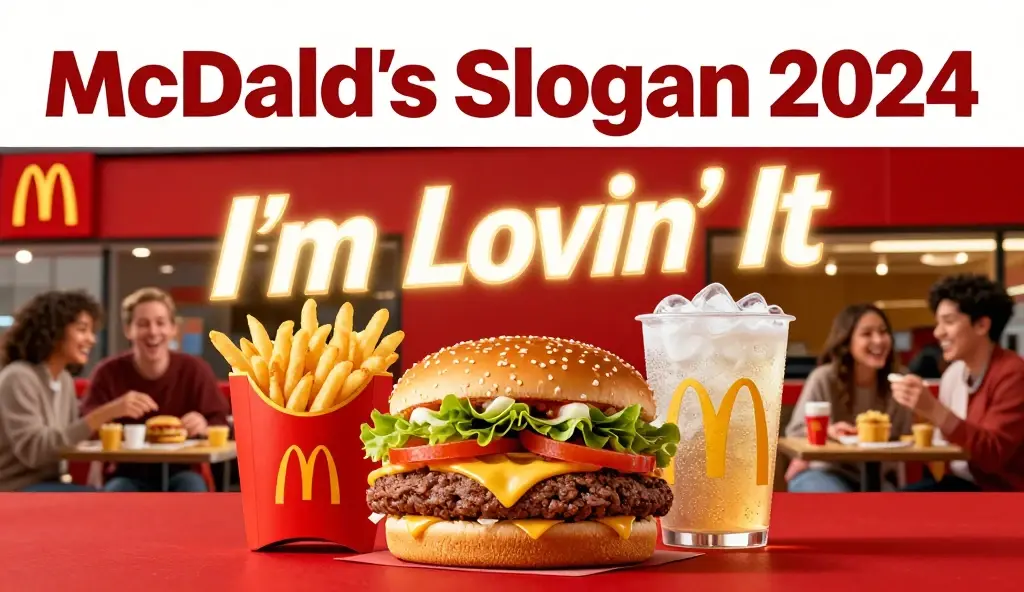
The official McDonald’s slogan in 2024 was “I’m lovin’ it.” The familiar phrase had already represented the fast-food brand for more than two decades, yet it remained central to McDonald’s global identity throughout the year.
McDonald’s did not replace its main slogan during 2024. Instead, the company placed it behind creative campaigns built around anime, affordability, nostalgia, collectibles, mobile ordering, and fan culture. Customers saw campaigns such as WcDonald’s, the $5 Meal Deal, and Collector’s Edition Cups, but these promotions supported the larger brand rather than becoming permanent replacements for “I’m lovin’ it.”
The slogan works because it focuses on a personal feeling. It does not tell customers what they should enjoy. It sounds like someone expressing genuine satisfaction after eating a favorite meal.
This guide explains the meaning of the McDonald’s tagline, its history, its famous five-note jingle, major 2024 campaigns, and the older slogans that helped shape one of the most recognizable restaurant brands in the world.
What Was the McDonald’s Slogan in 2024?
The main McDonald’s slogan 2024 audiences continued to recognize was “I’m lovin’ it.” McDonald’s introduced the campaign globally in 2003, and its corporate media library continued to feature the official “i’m lovin’ it” wordmark. No permanent replacement was announced for the slogan during 2024. (McDonald’s Corporation)
- 🍔 Official slogan: “I’m lovin’ it.”
- 📅 Year used: The phrase remained associated with McDonald’s in 2024.
- 🌍 Global identity: It worked across many international markets.
- 🎵 Audio signature: The slogan often followed the five-note jingle.
- ❤️ Main emotion: The wording expresses enjoyment and satisfaction.
- 🙋 Personal voice: “I’m” makes the statement feel individual.
- ⏱️ Short length: The line contains only three main words.
- 🧠 Easy recall: Simple language helps customers remember it.
- 📺 Advertising flexibility: It can close television and digital commercials.
- 📱 Social value: The phrase fits captions and short-form videos.
- 🛍️ Packaging value: It remains readable on bags, cups, and boxes.
- 🏪 Restaurant use: It complements the Golden Arches without competing with them.
- 🌟 Brand position: It connects McDonald’s with enjoyable moments.
- 🍟 Menu flexibility: It can represent burgers, fries, drinks, and desserts.
- 👨👩👧👦 Broad appeal: The phrase does not target only one age group.
- 🔄 Campaign support: Temporary promotions can sit beneath the main slogan.
- 🗣️ Natural language: It sounds more conversational than a corporate claim.
- 🎯 Direct answer: McDonald’s did not adopt a new permanent slogan for 2024.
- ✅ Correct phrase: The established tagline remained “I’m lovin’ it.”
What Does “I’m Lovin’ It” Mean?
“I’m lovin’ it” communicates enjoyment in the present moment. Rather than making a technical claim about food quality, price, or speed, it presents a personal reaction. The customer becomes the speaker, which allows the slogan to represent many experiences, from enjoying fries alone to sharing a Happy Meal with family.
- ❤️ “Lovin’” expresses strong enjoyment without sounding formal.
- 🙋 “I’m” puts the customer first instead of the company.
- ⏳ The present tense feels immediate and connected to the moment.
- 🍔 The meaning can apply to any menu item.
- 😊 The phrase communicates positive emotion quickly.
- 🗣️ The dropped “g” creates a casual speaking style.
- 🌍 Its simple message can adapt to different languages.
- 🎵 The rhythm makes the wording easy to sing.
- 🧠 Customers can remember it after hearing it briefly.
- 📸 The phrase works with visual moments of enjoyment.
- 👥 Different customers can attach their own experiences to it.
- 🍟 The slogan does not depend on one signature product.
- 🎉 It can represent everyday meals and special promotions.
- 🤝 It creates emotional closeness without a long explanation.
- 🛒 The line encourages desire without directly demanding a purchase.
- 🎭 It can feel playful, warm, nostalgic, or energetic.
- 🔁 Repeated use strengthens its connection with McDonald’s.
- ✨ The message turns a meal into a positive feeling.
- 🎯 Its core meaning is simple: the customer enjoys the experience.
Was “I’m Lovin’ It” Still Official in 2024?
Yes. “I’m lovin’ it” remained McDonald’s established global brand line in 2024. The company’s official history identifies it as the first global McDonald’s advertising campaign, and its corporate media assets include a dedicated slogan wordmark. McDonald’s 2024 investor material also continued to recognize the campaign as a major moment in its strategic history. (McDonald’s Corporation)
- ✅ No permanent replacement was announced during 2024.
- 🍔 The phrase remained linked to the main McDonald’s brand.
- 🎵 Its audio logo continued supporting brand recognition.
- 🌍 International markets could translate or adapt the message.
- 📺 Individual commercials did not always display the full line.
- 📱 Digital campaigns sometimes emphasized products over the slogan.
- 🏷️ Promotional phrases did not automatically become official taglines.
- 🍟 The $5 Meal Deal was an offer, not a new brand slogan.
- 🎌 WcDonald’s was a campaign concept, not a permanent replacement.
- 🥤 Collector’s Edition was a promotion, not the corporate tagline.
- 🎨 Modern branding can retain a slogan without showing it everywhere.
- 🧠 The jingle can remind customers of the words without displaying them.
- 🟡 The Golden Arches also carry strong recognition independently.
- 🔄 The slogan acts as a long-term platform for changing campaigns.
- ❤️ Its emotional message remains broad enough for new audiences.
- 👥 Customers already understand its connection with the restaurant.
- 🕰️ Long-term use has strengthened its cultural familiarity.
- 🎯 Campaign themes may change while the master slogan remains stable.
- 📌 Therefore, “I’m lovin’ it” is the correct 2024 answer.
When Did McDonald’s Introduce “I’m Lovin’ It”?
McDonald’s launched “i’m lovin’ it” in Munich, Germany, on September 2, 2003. The company describes it as its first global advertising campaign. The launch gave McDonald’s a consistent message that could work across countries while allowing local teams to adapt the language and creative execution. (McDonald’s Corporation)
- 📅 Launch year: 2003.
- 📍 Launch city: Munich, Germany.
- 🌍 Campaign scale: It became McDonald’s first global campaign.
- 🇩🇪 German version: The idea appeared as “ich liebe es.”
- 🇺🇸 English version: It became “I’m lovin’ it.”
- 🎯 Strategic goal: Create one recognizable global message.
- 🎵 Music played a major role from the beginning.
- 🧠 The campaign combined words with an audio identity.
- 🗣️ Simple vocabulary made translation easier.
- ❤️ Emotion replaced a detailed product description.
- 🙋 The customer’s voice became central to the campaign.
- 📺 Television helped spread the message internationally.
- 📻 Radio allowed the jingle to work without visual branding.
- 🛍️ Packaging reinforced the phrase beyond advertisements.
- 🏪 Restaurants could use consistent global brand materials.
- 🔄 Local markets retained room for cultural adaptation.
- 🕰️ The campaign continued far longer than earlier taglines.
- 🌟 Its longevity made it part of popular culture.
- 🏆 By 2024, the slogan had represented McDonald’s for 21 years.
Why the McDonald’s Jingle Became So Famous
The words “I’m lovin’ it” became even more memorable because of the five-note “ba da ba ba ba” audio logo. Music helped McDonald’s communicate its identity even when customers could not see the restaurant name or Golden Arches. The campaign’s musical history has involved multiple creative contributors and extensive public discussion. (Pitchfork)
- 🎵 Five notes create a compact audio signature.
- 👂 Listeners can identify the brand before hearing its name.
- 🧠 Melody often stays in memory longer than plain speech.
- 🔁 The same sound can appear across different campaigns.
- 📺 It works at the beginning or end of a commercial.
- 📻 It remains effective in audio-only advertising.
- 📱 Short-form videos can use it within seconds.
- 🌍 The melody does not require translation.
- 🗣️ Different languages can follow the same musical pattern.
- ❤️ The upbeat sound supports the slogan’s positive emotion.
- 🍔 It links many menu items to one master brand.
- 🧒 Children can repeat the tune easily.
- 🧑 Adults recognize it through long-term exposure.
- 🎤 Artists can perform different versions without losing recognition.
- 🎨 The arrangement can change with each campaign’s mood.
- 🔊 A short audio logo works well in busy media environments.
- 🏪 The sound immediately brings the restaurant to mind.
- 🟡 It functions like the audio version of the Golden Arches.
- ✨ The jingle helped turn a short slogan into a complete brand asset.
How McDonald’s Used Its Slogan Strategy in 2024
McDonald’s marketing in 2024 focused on culturally relevant campaigns, value, fan participation, and familiar brand memories. The company’s annual reporting highlighted WcDonald’s, Collector’s Edition Cups, and affordability programs as major examples of its marketing activity. These campaigns added fresh stories without requiring a new permanent slogan. (McDonald’s Corporation)
- 🎌 Anime culture inspired the WcDonald’s campaign.
- 🥤 Collector’s Edition Cups brought back nostalgic designs.
- 💵 The $5 Meal Deal emphasized affordability.
- 📱 Mobile offers encouraged digital ordering.
- 🍟 Free Fries Friday supported app engagement.
- 🌍 Major ideas appeared across multiple global markets.
- 👥 Fan interests shaped creative decisions.
- 🎨 Packaging became part of the entertainment experience.
- 📺 Campaigns extended beyond traditional television commercials.
- 📖 Manga and animated stories supported product promotion.
- 🧠 Nostalgia helped older customers reconnect with the brand.
- 🧒 Modern collaborations introduced the brand to younger audiences.
- ❤️ The established slogan provided emotional consistency.
- 🟡 The Golden Arches connected every campaign visually.
- 🔄 Short-term themes refreshed a long-term identity.
- 🛍️ Collectibles gave customers a reason to return.
- 🎯 Value advertising responded to practical customer concerns.
- ✨ Cultural campaigns made the brand feel current.
- 🍔 “I’m lovin’ it” remained broad enough to support all these ideas.
The WcDonald’s Campaign and the 2024 Slogan
McDonald’s launched WcDonald’s on February 26, 2024, in more than 30 markets. The campaign transformed a fictional McDonald’s-inspired restaurant commonly seen in anime into a real promotion. It included manga-style packaging, Savory Chili WcDonald’s Sauce, digital manga, and four animated shorts created with Studio Pierrot. (McDonald’s Corporation)
- 🎌 WcDonald’s celebrated McDonald’s long presence in anime culture.
- 🔄 The Golden Arches were flipped into a “W.”
- 🍗 Chicken McNuggets became a central campaign product.
- 🌶️ Savory Chili WcDonald’s Sauce added a limited-time flavor.
- 🎨 Manga artist Acky Bright helped shape the visual world.
- 🎬 Studio Pierrot produced official animated shorts.
- 📖 Customers could access new manga chapters digitally.
- 📦 Special packaging carried campaign characters and artwork.
- 🌍 The promotion appeared in more than 30 markets.
- 📅 It began on February 26, 2024.
- 🤝 The idea recognized creativity already developed by anime fans.
- 📱 Codes connected physical packaging with online content.
- 🧠 The altered logo remained recognizable despite the flipped letter.
- 🎭 Different anime genres inspired the weekly episodes.
- 🍔 The campaign expanded the McDonald’s universe without renaming the company permanently.
- 🎯 WcDonald’s was not the official replacement slogan.
- ❤️ It still fit the enjoyment expressed by “I’m lovin’ it.”
- 🌟 The promotion showed how established brands can join fan culture.
- 🔁 After the limited campaign, the standard McDonald’s identity remained.
Collector’s Edition Cups and McDonald’s Nostalgia Marketing
McDonald’s introduced its global Collector’s Edition in August 2024. The promotion featured cups inspired by memorable brand collaborations and collectibles involving McDonald’s, Coca-Cola, Mattel, Universal, Sanrio, and TY Beanie Babies. The company presented the cups as a way for longtime fans to revisit memories while helping younger customers create new ones. (McDonald’s Corporation)
- 🥤 The promotion centered on limited-edition collectible cups.
- 📅 The release began on August 13, 2024.
- 🌍 Cups appeared in more than 30 countries.
- 🧸 Designs referenced familiar toys and characters.
- 🎀 Barbie appeared within the nostalgic collection.
- 🟣 Grimace inspired part of the retro appeal.
- 🐱 Sanrio connections attracted character collectors.
- 🫘 Beanie Babies recalled past Happy Meal excitement.
- 🎬 Universal properties expanded the entertainment connection.
- 🥤 Coca-Cola imagery added another familiar global brand.
- 🧠 Collectibles helped customers remember previous McDonald’s experiences.
- 👨👩👧👦 Different designs appealed to different generations.
- 📸 Visual cups encouraged sharing on social media.
- 🛍️ Limited availability created a reason to visit promptly.
- 🔁 Multiple designs encouraged repeat purchases.
- ❤️ The campaign emphasized emotional memories over product features.
- 🎯 Collector’s Edition was a campaign title, not a new slogan.
- 🍔 The promotion still supported McDonald’s broader enjoyment message.
- ✨ Nostalgia gave “I’m lovin’ it” a personal, memory-based meaning.
The $5 Meal Deal and McDonald’s Value Message
McDonald’s introduced its $5 Meal Deal in participating U.S. restaurants on June 25, 2024. The offer included a McDouble or McChicken, small fries, four-piece Chicken McNuggets, and a small soft drink. The company later extended the promotion in many local markets after strong customer participation. (McDonald’s Corporation)
- 💵 The campaign addressed customer demand for affordability.
- 🍔 Customers could select a McDouble or McChicken.
- 🍟 A small order of fries came with the meal.
- 🍗 The bundle included four Chicken McNuggets.
- 🥤 A small soft drink completed the offer.
- 📅 The promotion launched on June 25, 2024.
- 🇺🇸 It appeared at participating U.S. restaurants.
- 📱 App promotions offered additional ways to save.
- 🍟 Free Fries Friday continued through the end of 2024.
- 🏪 Participation and prices could vary by location.
- 🔄 Many markets extended the deal into December.
- 👥 The offer attracted tens of millions of customers, according to McDonald’s.
- 🎯 Its message focused on clear, understandable value.
- 🧠 The $5 price gave customers an easy number to remember.
- 🛍️ Bundling simplified the purchase decision.
- ❤️ Affordability helped the brand protect everyday relevance.
- 📣 “$5 Meal Deal” worked as an offer name rather than a corporate slogan.
- 🍔 The promotion complemented the main McDonald’s tagline.
- ✅ It did not replace “I’m lovin’ it” in 2024.
Why McDonald’s Did Not Need a New Slogan in 2024
A brand does not need to replace its slogan every time it launches a promotion. McDonald’s already had a globally recognized phrase, a famous audio logo, the Golden Arches, memorable menu products, and strong character assets. Its 2024 campaigns could therefore focus on current customer interests while the established slogan maintained continuity.
- 🧠 Customers already connected the phrase with McDonald’s.
- 🎵 The jingle provided immediate audio recognition.
- 🟡 The Golden Arches supplied strong visual recognition.
- 🍔 Products such as the Big Mac carried their own familiarity.
- 🍟 World Famous Fries supported product-level branding.
- 🧒 Happy Meal already functioned as a powerful sub-brand.
- 📱 The slogan remained short enough for digital channels.
- 🌍 Its emotional meaning worked across many cultures.
- 🔄 Campaigns could change without confusing customers.
- ❤️ Enjoyment remained relevant to every menu category.
- 🎌 WcDonald’s could fit under the established brand platform.
- 💵 Value campaigns could focus directly on price.
- 🥤 Collector campaigns could emphasize memory and fandom.
- 🛍️ Limited offers did not require permanent brand changes.
- 📣 Frequent slogan changes could weaken recognition.
- 🕰️ Long-term consistency increased cultural familiarity.
- 🎨 Creative teams still had room to reinterpret the message.
- 🎯 The slogan described a feeling rather than one temporary promise.
- ✨ Its flexibility remained its greatest strategic strength.
Famous McDonald’s Slogans Before “I’m Lovin’ It”
McDonald’s used numerous advertising lines before introducing its global slogan in 2003. These campaigns often focused on restaurant recognition, convenience, personal service, family enjoyment, value, and the idea of taking a break. Several phrases became strongly associated with specific eras of American advertising. (Wikipedia)
- 🟡 “Look for the Golden Arches” emphasized the restaurant symbol.
- 🏪 “McDonald’s Is Your Kind of Place” presented a welcoming destination.
- 😌 “You Deserve a Break Today” focused on relief and convenience.
- 🤲 “We Do It All for You” highlighted customer service.
- 🏆 “Nobody Can Do It Like McDonald’s Can” expressed competitive confidence.
- 🤝 “McDonald’s and You” centered the customer relationship.
- 😋 “It’s a Good Time for the Great Taste of McDonald’s” connected flavor with occasion.
- 🎉 “Food, Folks and Fun” emphasized meals and social experiences.
- 🛍️ “Good Food, Good Value” made a direct product-and-price promise.
- 🎯 “What You Want Is What You Get” focused on customer choice.
- ⏰ “Have You Had Your Break Today?” revisited an earlier campaign theme.
- 🏡 “My McDonald’s” attempted to create personal ownership.
- 📣 “Did Somebody Say McDonald’s?” used a memorable question.
- 😊 “We Love to See You Smile” emphasized customer happiness.
- ❤️ “I’m Lovin’ It” shifted the message into the customer’s voice.
- 🔁 Some slogans returned in revised forms.
- 🌍 Different countries also used local advertising lines.
- 📺 Television jingles helped many phrases become memorable.
- 🕰️ Each slogan reflected the marketing priorities of its period.
Why “You Deserve a Break Today” Became Iconic
McDonald’s introduced “You Deserve a Break Today” in the early 1970s. The line became one of the most famous advertising jingles of its era. Advertising Age later recognized the associated jingle as one of the most important of the twentieth century, reflecting how strongly it entered popular memory. (WIRED)
- 😌 The slogan recognized that customers felt busy and tired.
- 🙋 “You” addressed the listener directly.
- 🏆 “Deserve” made the meal feel like a reward.
- ⏸️ “Break” connected McDonald’s with rest and convenience.
- 📅 “Today” encouraged immediate action.
- 🎵 A memorable jingle helped audiences retain the words.
- 👨👩👧👦 The message could appeal to workers and families.
- 🍔 The restaurant became an escape from cooking.
- 🏪 Going to McDonald’s felt like a simple change of routine.
- ❤️ The line showed empathy before presenting the product.
- 🗣️ It sounded encouraging rather than demanding.
- 🧠 The phrase attached McDonald’s to a common human need.
- 📺 Visuals could show people enjoying relief from daily responsibilities.
- 📻 The jingle worked effectively through radio.
- 🔄 Later campaigns reused the idea of a daily break.
- 🌟 The slogan became larger than one menu item.
- 🕰️ Many customers still remember it decades later.
- 🎯 Its strength came from solving an emotional problem.
- ✨ It proved that a restaurant slogan could sell a feeling.
How “Look for the Golden Arches” Built Recognition
“Look for the Golden Arches” belonged to an earlier period when McDonald’s needed customers to recognize and find its growing restaurant network. The line connected the company name with a simple visual instruction. As motorists saw the yellow arches from the road, the slogan helped turn architecture into a navigational brand asset.
- 🟡 The slogan directed attention toward a visual symbol.
- 👀 “Look” gave customers a clear action.
- 🛣️ The arches were visible to people traveling by car.
- 🏪 The sign helped identify restaurant locations quickly.
- 🧠 Repeated exposure built shape-based recognition.
- 🌟 The symbol remained memorable without much text.
- 🍔 Customers learned what experience the arches represented.
- 🚗 Roadside visibility supported the expanding restaurant model.
- 📺 Advertisements reinforced the same visual cue.
- 📻 Radio could tell listeners what symbol to find.
- 👨👩👧👦 Families could recognize the destination from a distance.
- 🔄 The arches remained useful as restaurant designs changed.
- 🎨 Yellow provided a bright, recognizable visual identity.
- 🟥 Red and yellow became closely associated with the brand.
- 📍 The logo functioned as a location marker.
- 🌍 The symbol later supported international recognition.
- 🗣️ The wording was direct and easy to follow.
- 🕰️ The Golden Arches eventually became recognizable without instructions.
- ✨ The campaign helped transform a building feature into a global logo.
The Meaning of “It’s a Good Time for the Great Taste”
McDonald’s used variations of “It’s a Good Time for the Great Taste of McDonald’s” during the 1980s. The slogan linked a positive social moment with the restaurant’s food. Rather than focusing only on convenience, it suggested that visiting McDonald’s could become part of an enjoyable occasion.
- ⏰ “Good time” gave the meal an emotional setting.
- 😋 “Great taste” made flavor the central product promise.
- 🍔 The McDonald’s name completed the message clearly.
- 🎉 The slogan worked with family and social scenes.
- 😊 Its tone felt cheerful and optimistic.
- 🎵 The wording supported musical advertising.
- 🗣️ Repetition of “good” and “great” strengthened positivity.
- 👥 Customers could associate the brand with shared experiences.
- 🍟 Different menu products could appear beneath the same message.
- 📺 Television commercials could show active, happy environments.
- 🌍 The basic idea was adaptable for regional campaigns.
- 🧠 The phrase connected taste with a memorable occasion.
- ❤️ It sold emotional enjoyment alongside food.
- 🏪 The restaurant became a place for positive moments.
- 🔄 Later slogans continued emphasizing customer feelings.
- 🙋 However, the statement still came mainly from the brand.
- ✨ “I’m lovin’ it” later made the customer the speaker.
- 🕰️ The older slogan marked an important step in that evolution.
- 🎯 Its core promise was simple: good moments and enjoyable food belong together.
Why “Did Somebody Say McDonald’s?” Was Memorable
“Did Somebody Say McDonald’s?” used a question instead of a traditional product claim. The wording suggested that merely hearing the restaurant’s name could attract attention, trigger appetite, or change the direction of a conversation. It became recognizable in several markets before “I’m lovin’ it” created a unified global platform.
- ❓ The question creates immediate curiosity.
- 👂 It makes the brand name sound difficult to ignore.
- 🍔 Hearing “McDonald’s” becomes a trigger for hunger.
- 🗣️ The line resembles natural conversation.
- 😂 Commercials could use surprise and humor.
- 🧠 Questions encourage audiences to respond mentally.
- 📣 The brand name receives emphasis at the end.
- 👥 Multiple characters could react to the same word.
- 🎬 The phrase creates an easy commercial storyline.
- 🔁 It can repeat without sounding like a formal claim.
- 📻 The question works especially well in audio advertising.
- 📺 Visual reactions can provide the comedic payoff.
- 😋 The line connects recognition with appetite.
- 🏪 It reminds customers that the restaurant is familiar.
- 🌍 Markets could translate the conversational structure.
- 🎵 A musical treatment could strengthen recall.
- ⏱️ The short wording fits brief advertisements.
- 🔄 It prepared the brand for more casual language.
- ✨ Its conversational personality anticipated “I’m lovin’ it.”
What Happened to “Lovin’ Beats Hatin’”?
“Lovin’ Beats Hatin’” appeared as a campaign phrase associated with McDonald’s positivity-focused advertising in 2015. It was designed to complement the established “I’m lovin’ it” platform rather than permanently replace it. The response was mixed, and the original slogan remained the stronger long-term brand line. (Food & Wine)
- ❤️ The phrase retained the familiar word “lovin’.”
- 🚫 “Hatin’” introduced a direct emotional contrast.
- 🌍 The message attempted to promote positivity.
- 📱 It reflected the increasingly argumentative tone of online culture.
- 🎯 The phrase supported a campaign rather than a complete rebrand.
- 🧠 Its connection with “I’m lovin’ it” was immediately clear.
- 📣 The contrast made the line easy to discuss.
- ⚖️ However, negative wording also introduced tension.
- 🍔 The phrase said little about the restaurant experience itself.
- 👥 Some customers understood the social message.
- 🤔 Others considered it less natural than the main slogan.
- 📺 A high-profile campaign increased public attention.
- 🔁 The brand continued relying on its established tagline afterward.
- ❤️ “I’m lovin’ it” remained simpler and more personal.
- 🗣️ The original line also sounded more like everyday speech.
- 🕰️ Long-term familiarity gave the older slogan an advantage.
- 🎨 The campaign showed that brands can test supporting messages.
- ✅ A temporary phrase does not always signal a permanent slogan change.
- 📌 It was not McDonald’s official slogan in 2024.
McDonald’s Slogan in Different Countries and Languages
“I’m lovin’ it” became a global platform because McDonald’s could translate or adapt its meaning for local audiences while retaining the same identity, music, and visual branding. The company’s German history page describes the 2003 introduction of “ich liebe es,” while other markets have used translations that communicate a similar feeling of enjoyment. (McDonald’s)
- 🇩🇪 Germany: “Ich liebe es.”
- 🇪🇸 Spanish-speaking markets: Variations commonly express “I love it.”
- 🇫🇷 French markets: Local language communicates enjoyment naturally.
- 🇮🇹 Italian markets: The central emotional meaning remains positive.
- 🇵🇹 Portuguese markets: The wording adapts to familiar speech.
- 🇸🇦 Arabic markets: The idea can appear in localized language.
- 🇨🇳 Chinese markets: Translation preserves the enjoyment theme.
- 🇯🇵 Japanese campaigns: Local creative can sit beside global branding.
- 🇵🇭 Philippine campaigns: English and local language may appear together.
- 🇦🇺 Australia: “Macca’s” also operates as a familiar local nickname.
- 🇨🇦 Canada: English and French needs shape regional communication.
- 🌍 The five-note melody remains recognizable across languages.
- 🟡 The Golden Arches provide a universal visual link.
- 🍔 Core menu products strengthen international consistency.
- 🗣️ Translations need to sound natural rather than literal.
- 🎵 The rhythm may require small wording adjustments.
- 🎨 Local campaigns can reflect regional humor and culture.
- 🔄 The central brand feeling remains consistent.
- ❤️ Across markets, the slogan communicates personal enjoyment.
Why “I’m Lovin’ It” Still Worked in Digital Marketing
By 2024, customers interacted with McDonald’s through apps, delivery platforms, loyalty programs, social media, self-ordering kiosks, websites, and physical restaurants. “I’m lovin’ it” remained useful because its short, emotional wording could move between these channels without requiring a detailed explanation.
- 📱 The phrase fits comfortably on a mobile screen.
- 🎵 Its audio logo works in short-form video.
- 📸 Customers can pair it with food photographs.
- 🔔 App notifications can reference enjoyment and cravings.
- 🛵 Delivery campaigns can use the same emotional message.
- 🛍️ Digital offers can sit beneath the master brand line.
- 🎮 Entertainment collaborations can adapt its playful tone.
- 🎌 WcDonald’s showed its compatibility with anime culture.
- 🥤 Collector’s Edition connected it with nostalgia.
- 💵 Value offers gave the enjoyment message practical support.
- 👥 User-generated content can express “I’m” naturally.
- 🧠 The five-note sound works even when viewers scroll quickly.
- 🌍 Global consistency helps customers recognize international content.
- 🔄 The phrase can support new products without rewriting the identity.
- 🎨 Designers can use the words or rely only on the jingle.
- ❤️ Emotion remains valuable across every platform.
- 🟡 The logo and sound reduce the need for repeated explanation.
- ⏱️ Customers can process the message almost instantly.
- ✨ Its simplicity made it suitable for a fragmented media environment.
Branding Lessons From the McDonald’s Slogan 2024
The McDonald’s slogan 2024 demonstrates that a long-running tagline can remain useful when the underlying brand position stays relevant. McDonald’s refreshed its marketing through cultural partnerships, collectibles, value offers, and digital experiences while protecting the emotional message customers already knew.
- 🎯 Build a slogan around one clear emotional idea.
- 🙋 Let the customer become part of the message.
- 🧠 Use language people can remember after one exposure.
- 🎵 Consider how the slogan sounds, not only how it looks.
- 🌍 Create a concept that can cross cultural boundaries.
- 🔄 Allow temporary campaigns to refresh the master brand.
- 🕰️ Do not replace a strong slogan only because it is old.
- ❤️ Emotional language often lasts longer than product details.
- 🍔 Make sure the customer experience supports the promise.
- 🟡 Use visual assets consistently beside the tagline.
- 📱 Keep the wording useful on small digital screens.
- 📣 Distinguish promotional names from permanent slogans.
- 👥 Listen to fan culture and customer behavior.
- 🎨 Give creative teams room to reinterpret the central idea.
- 💵 Support emotional advertising with practical customer value.
- 🛍️ Use packaging as part of the brand story.
- ✨ Combine consistency with culturally relevant execution.
- ⚠️ Avoid forcing the slogan into every single communication.
- 🏆 The strongest slogan becomes a platform, not just a sentence.
FAQs:
Q1. What was McDonald’s slogan in 2024?
A: McDonald’s official slogan in 2024 was “I’m lovin’ it.” The company did not announce a permanent replacement during that year.
Q2. Did McDonald’s change its slogan in 2024?
A: No. McDonald’s launched several major campaigns in 2024, but none permanently replaced “I’m lovin’ it.”
Q3. Was WcDonald’s the new McDonald’s slogan?
A: No. WcDonald’s was a limited anime-inspired campaign that began in February 2024. It was not the company’s new permanent slogan.
Q4. What does “I’m lovin’ it” mean?
A: The phrase expresses personal, immediate enjoyment. It allows customers to describe how they feel about their food or McDonald’s experience.
Q5. When did McDonald’s start using “I’m lovin’ it”?
A: McDonald’s launched the slogan as its first global advertising campaign in Munich, Germany, on September 2, 2003.
Q6. How old was the McDonald’s slogan in 2024?
A: “I’m lovin’ it” was approximately 21 years old in 2024 because McDonald’s introduced it in 2003.
Q7. What is the McDonald’s slogan song?
A: The slogan is associated with the five-note “ba da ba ba ba” jingle, which functions as an audio logo for the brand.
Q8. Is “You Deserve a Break Today” still McDonald’s slogan?
A: No. “You Deserve a Break Today” was a famous older McDonald’s advertising line. It is not the current global slogan.
Conclusion:
The official McDonald’s slogan 2024 was “I’m lovin’ it.”
Although McDonald’s introduced major promotions during the year, including WcDonald’s, Collector’s Edition Cups, and the $5 Meal Deal, these campaigns did not replace the established global tagline.

Kevin Turner creates informative branding content focused on business growth, memorable taglines, and creative marketing ideas.