
Unlike a conventional food slogan that merely describes taste or quality, “Taste the Rainbow” creates an experience. You cannot literally taste a rainbow, yet the phrase feels instantly understandable when paired with brightly colored, fruit-flavored candy. That imaginative contradiction is exactly what makes the slogan powerful.
In 2026, Mars still identifies “Taste the Rainbow®” with Skittles across its official brand portfolio. The company’s website and recent campaigns continue using rainbow-centered language, proving that the original idea remains commercially valuable decades after its introduction. de explores the meaning, history, psychology, marketing strategy, cultural influence, and enduring relevance of the Skittles tagline. It also explains what businesses, copywriters, and brand strategists can learn from one of the most memorable candy slogans ever created.
What Is the Official Skittles Slogan?
The official Skittles slogan is “Taste the Rainbow.” It transforms a simple candy-eating moment into something colorful and imaginative. Rather than listing flavors or ingredients, the line invites consumers to experience the brand’s entire sensory world. Mars continues to associate the registered tagline with Skittles in 2026. ficial tagline:** The best-known Skittles slogan is “Taste the Rainbow.”
- ®️ Registered identity: Mars frequently presents it as “Taste The Rainbow®.”
- 🍬 Product connection: The rainbow represents the candy’s assortment of bright colors and fruity flavors.
- 👅 Sensory language: “Taste” turns a visual symbol into an edible experience.
- 🎨 Color association: The slogan reinforces Skittles’ red, orange, yellow, green, and purple appearance.
- 💭 Imaginative promise: Consumers are invited to experience something impossible in real life.
- ⚡ Immediate recognition: Many people identify the brand from the slogan alone.
- 🧠 Memory advantage: Its unusual imagery makes it easier to remember than a descriptive phrase.
- 😊 Emotional tone: The line feels playful, cheerful, energetic, and slightly absurd.
- 🛍️ Purchase cue: It reminds shoppers that one package contains multiple colorful flavors.
- 📺 Advertising foundation: Skittles commercials repeatedly build surreal situations around the rainbow concept.
- 📦 Packaging compatibility: The phrase works naturally beside the brand’s colorful packaging.
- 🌍 Global usability: Its basic idea can travel across cultures with relatively little explanation.
- 🔊 Voice-search relevance: It directly answers searches such as “What is the Skittles slogan?”
- ✍️ Copywriting strength: Every word performs a clear strategic role.
- 🎯 Brand positioning: Skittles owns a space built around flavor, color, imagination, and unpredictability.
- 🔁 Long-term flexibility: The rainbow concept can support campaigns, products, promotions, and social content.
- 🧩 Semantic connection: Related terms include candy tagline, food slogan, fruit candy, rainbow candy, and brand catchphrase.
- 🏆 Marketing legacy: “Taste the Rainbow” remains one of the most recognizable confectionery slogans.
What Does “Taste the Rainbow” Mean?
“Taste the Rainbow” means experiencing the colorful range of Skittles flavors in a single handful or package. On a deeper level, it suggests variety, surprise, playfulness, and sensory excitement. The slogan does not ask consumers merely to eat candy; it invites them to enter the imaginative universe represented by the Skittles rainbow.
- 🌈 Literal interpretation: Different candy colors represent a varied flavor experience.
- 🍓 Flavor variety: A handful may contain strawberry, lime, grape, lemon, orange, or other varieties.
- 👀 Visual appeal: The rainbow begins attracting attention before the candy is tasted.
- 👅 Taste expectation: Bright colors prepare the consumer for fruity sweetness.
- 🎭 Imaginative meaning: A natural phenomenon becomes something playful and edible.
- ✨ Sense of wonder: The phrase makes an ordinary snack feel more magical.
- 🎉 Celebration: Rainbows commonly communicate joy, excitement, and positive energy.
- 🧺 Abundance: A rainbow suggests that consumers receive multiple experiences rather than one flavor.
- 🌀 Surprise: Skittles advertising often presents the rainbow in unexpected or surreal ways.
- 🤹 Playfulness: The line does not take itself too seriously.
- 🚪 Invitation: “Taste” functions as an active command encouraging participation.
- 🛒 Product trial: The phrase subtly encourages consumers to buy and sample the candy.
- ❤️ Emotional association: It connects Skittles with happy, lighthearted moments.
- 🧠 Conceptual blending: The slogan combines sight and taste in one memorable mental image.
- 🎨 Brand distinction: Competitors may sell colorful candy, but Skittles claims the rainbow itself.
- 📣 Campaign potential: Advertisers can interpret the rainbow literally, metaphorically, or absurdly.
- 🗣️ Conversational simplicity: The wording is easy to say, hear, repeat, and share.
- 🌟 Aspirational feeling: Consumers are promised more than sweetness—they are promised an experience.
- 🔍 Search meaning: People looking up the Skittles slogan usually want this simple explanation and its history.
The History and Origin of the Skittles Slogan
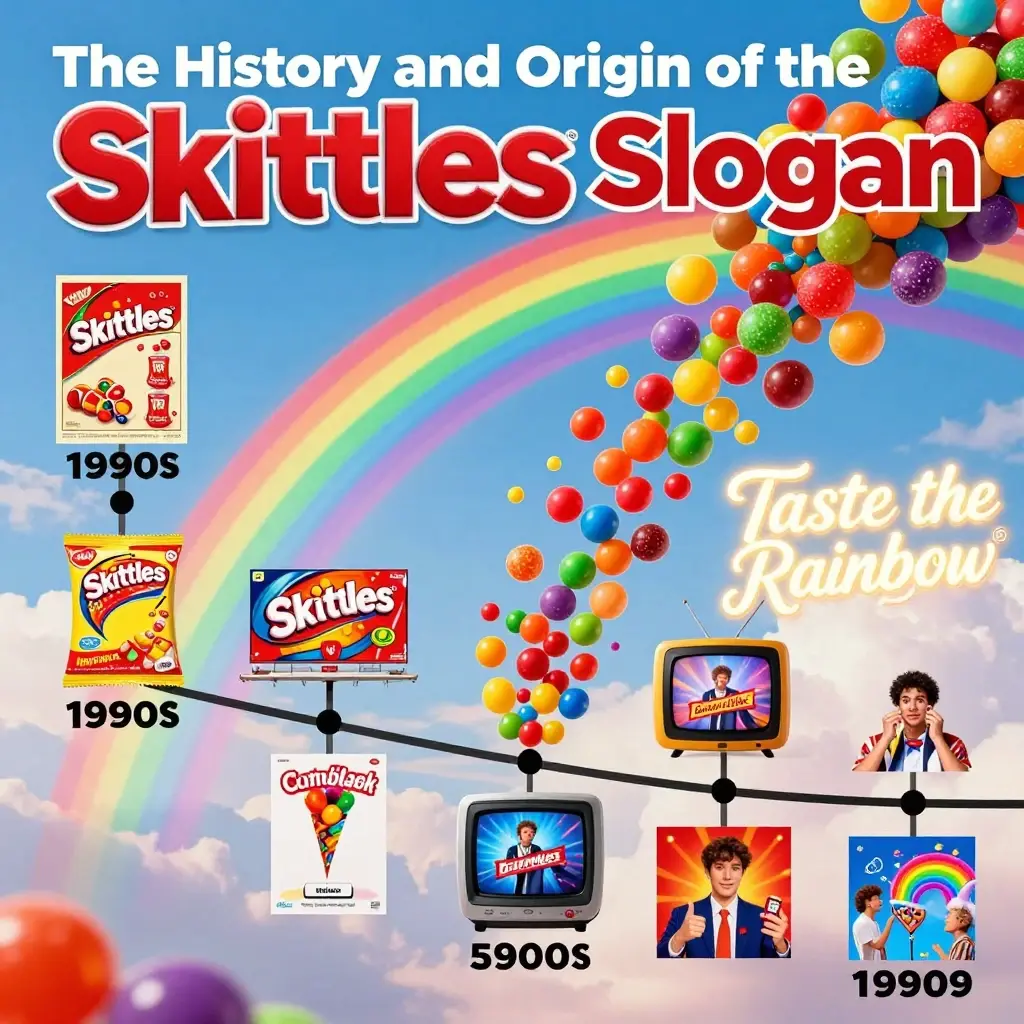
Skittles originated in the United Kingdom and was later introduced to the United States, where domestic production began in 1982. Mars’ official company history confirms that the candy was first imported into the United States in 1974. The “Taste the Rainbow” campaign is widely dated to 1994 and associated with advertising agency D’Arcy Masius Benton & Bowles. ritish beginnings:** Skittles first appeared in the United Kingdom before expanding internationally.
- 🇺🇸 American arrival: The candy was imported into the United States in 1974.
- 🏭 U.S. production: Manufacturing in the United States began in 1982.
- 📅 Campaign era: “Taste the Rainbow” is commonly traced to 1994.
- 🏢 Agency connection: D’Arcy Masius Benton & Bowles is credited with developing the campaign.
- 🌈 Strategic asset: The rainbow transformed product colors into a distinctive brand property.
- 🍬 Product truth: The slogan grew from something consumers could immediately see in each package.
- 🎬 Creative expansion: Advertisements turned the rainbow idea into strange, comic scenarios.
- 🧠 Brand memory: Repetition over many years strengthened recognition across generations.
- 📺 Television influence: Commercials helped give the slogan its eccentric personality.
- 🛍️ Retail reinforcement: Packaging and displays made the rainbow consistently visible at purchase.
- 🔁 Campaign continuity: Skittles retained the central idea while changing individual executions.
- 🌍 International reach: The phrase became connected with the brand in multiple markets.
- 🎭 Surreal identity: Later advertising made weirdness a recognizable part of the campaign.
- 💬 Cultural repetition: Consumers began quoting the line independently of advertisements.
- 📱 Digital transition: The rainbow concept adapted naturally to social media and online video.
- 🏆 Industry recognition: Rainbow-based campaigns have continued receiving marketing attention and awards.
- 🧪 Product innovation: New textures and flavor collections are regularly placed inside the same brand world.
- ⏳ Enduring relevance: The campaign has survived because its central idea is broader than one advertisement.
Why the Skittles Slogan Became So Memorable
A memorable slogan usually combines simplicity with something unexpected. “Taste the Rainbow” achieves both. Its words are understandable to a child, but its meaning is imaginative enough to interest adults. The phrase also creates a vivid picture, making it far easier to recall than a line based only on quality, value, or sweetness.
- 🧠 Mental imagery: Most people instantly picture a bright rainbow when they hear the line.
- 👅 Sensory action: The word “taste” activates thoughts of flavor and eating.
- 🌈 Visual ownership: Skittles repeatedly connects itself with one highly recognizable symbol.
- 🔤 Simple vocabulary: Every word is common and immediately understandable.
- ⚡ Compact structure: Four words communicate the complete creative idea.
- 🎵 Natural rhythm: The phrase sounds smooth when spoken aloud.
- 🤔 Impossible action: A person cannot literally taste a rainbow, making the line intriguing.
- 🍬 Visible proof: The colorful candy makes the imaginative claim feel believable.
- 🔁 Repeatability: Consumers can easily quote it after hearing it once or twice.
- 😄 Positive emotion: The slogan avoids fear, pressure, complexity, or seriousness.
- 🪄 Transformation: It turns an inexpensive snack into a miniature fantasy.
- 🎨 Distinctiveness: Few food slogans create such a clear visual world.
- 📺 Consistent exposure: Long-running advertising strengthened familiarity.
- 🎭 Unusual commercials: Surreal campaign ideas made the tagline harder to ignore.
- 📣 Strong imperative: The wording directly tells the audience what to do.
- 🧩 Product alignment: Color variety and flavor variety support the same message.
- 🌍 Broad accessibility: The core concept does not require specialist knowledge.
- 🛒 Shelf recognition: Rainbow graphics help reconnect the slogan with the package.
- 🏅 Brand attribution: People usually remember that “Taste the Rainbow” belongs to Skittles.
The Psychology Behind “Taste the Rainbow”
The effectiveness of the Skittles slogan is partly psychological. Consumers process color, flavor expectations, emotional associations, and verbal commands almost simultaneously. “Taste the Rainbow” activates curiosity while allowing the product’s appearance to validate the message. This makes the tagline feel creative without becoming confusing or disconnected from the candy.
- 🎨 Color stimulation: Bright colors naturally attract visual attention in busy retail environments.
- 🧠 Associative memory: Repeatedly pairing Skittles with rainbows strengthens brand recall.
- 👁️ Cross-sensory effect: Visual color can influence expectations about flavor and sweetness.
- 👅 Anticipatory taste: Reading “taste” can prompt consumers to imagine eating the candy.
- ❓ Curiosity gap: The impossible instruction encourages the mind to resolve its meaning.
- 😊 Positive symbolism: Rainbows are often connected with joy, hope, wonder, and discovery.
- 🎁 Reward expectation: Colorful candy may feel like a small, immediate treat.
- 🎲 Variety appeal: Multiple colors suggest that each handful offers a different combination.
- 👶 Childhood association: Bright colors and playful language can trigger nostalgic memories.
- 🪄 Fantasy framing: Imagination temporarily elevates an everyday confectionery product.
- ⚡ Processing fluency: Simple words reduce the mental effort required to understand the message.
- 🔁 Repetition effect: Long-term consistency increases familiarity and trust.
- 🎭 Benign absurdity: Strange ideas can be memorable when they remain harmless and entertaining.
- 🛍️ Impulse support: Strong color and a familiar line work well in quick purchase decisions.
- 👥 Social recognition: Shared familiarity makes the slogan easy to reference in conversation.
- 🔊 Phonetic simplicity: The phrase remains clear in video, audio, and spoken recommendations.
- 🧩 Semantic compression: One rainbow communicates color, range, wonder, and abundance.
- 📱 Shareability: Visually imaginative concepts perform naturally in short-form digital content.
- ❤️ Emotional encoding: People remember messages more easily when those messages create a feeling.
How Color Strengthens the Skittles Brand Message
Color is not merely decorative in Skittles branding. It is the organizing principle behind the product, packaging, advertising, and slogan. The rainbow gives the company a recognizable visual system that can remain consistent even when individual flavors, formats, promotions, and campaign ideas change.
- 🌈 Unified symbol: The rainbow brings every candy color into one recognizable image.
- 🔴 Red energy: Red can communicate excitement, sweetness, and appetite appeal.
- 🟠 Orange warmth: Orange contributes friendliness, energy, and citrus associations.
- 🟡 Yellow brightness: Yellow reinforces optimism, playfulness, and lemon flavor cues.
- 🟢 Green freshness: Green can signal lime, fruitiness, novelty, or contrast.
- 🟣 Purple richness: Purple adds visual depth and connects with grape-flavor expectations.
- 👀 Shelf visibility: Multiple saturated colors stand out among neutral surroundings.
- 📦 Packaging recognition: Rainbow graphics help shoppers identify Skittles quickly.
- 🎯 Brand consistency: The color system remains recognizable across product variations.
- 📸 Social appeal: Colorful candy is naturally photogenic and easy to feature in digital content.
- 🎬 Creative freedom: Advertisers can build characters, environments, and stories from rainbow imagery.
- 🛒 Impulse impact: Strong color can attract attention during fast shopping decisions.
- 🍭 Category relevance: Bright colors match consumer expectations for fruity confectionery.
- 🧠 Memory coding: People may remember the color pattern before recalling written details.
- 🪄 Fantasy element: A rainbow adds wonder to an otherwise familiar candy format.
- 🌍 Visual communication: Color can convey the core idea before a slogan is translated.
- 🎉 Occasion flexibility: Rainbow branding works for parties, holidays, entertainment, and gifting.
- 🔄 Product adaptability: New flavor lines can enter the established visual universe.
- 🏳️🌈 Context awareness: Rainbow symbolism can carry additional cultural meanings that require thoughtful execution.
How the Slogan Communicates Flavor and Variety
“Taste the Rainbow” succeeds because it makes variety feel like the product’s central benefit. Instead of promising one perfect flavor, Skittles offers a collection of fruity experiences. The official product range continues using rainbow-oriented language across chewy candy, gummies, sour options, Wild Berry varieties, and other extensions. rawberry association:** Red candy commonly signals a familiar berry flavor.
- 🍋 Lemon expectation: Yellow creates an immediate citrus connection.
- 🍊 Orange clarity: Orange color and orange flavor reinforce each other naturally.
- 🍇 Grape recognition: Purple gives consumers a familiar visual flavor cue.
- 🍈 Lime identity: Green supports the classic lime association in Original Skittles.
- 🌈 Mixed experience: One package offers several colors rather than a single uniform candy.
- 🤲 Handful variation: Every handful can contain a different flavor balance.
- 🎲 Small surprise: Consumers do not always know which color they will pick next.
- 👥 Sharing appeal: People can exchange, compare, or choose favorite colors.
- 🛍️ Value perception: Multiple flavors can make one package feel more varied.
- 🧺 Abundance cue: A rainbow visually suggests a broad range of options.
- 🧪 Innovation support: New flavors can be introduced without abandoning the master slogan.
- 🔥 Trend flexibility: Sweet, sour, spicy, gummy, or crunchy formats can still belong to the rainbow.
- 📦 Range navigation: Colors help customers distinguish products and flavor families.
- 😋 Taste anticipation: Seeing several colors encourages consumers to imagine several flavors.
- 🎉 Entertainment value: Choosing colors becomes part of the eating ritual.
- 📱 Content potential: Flavor rankings and taste tests create easy social-media participation.
- 🧠 Strong product logic: The slogan reflects an observable feature rather than an abstract claim.
- 🎯 Clear promise: Consumers understand that Skittles delivers colorful, fruit-forward variety.
The Voice and Personality of the Skittles Tagline
The Skittles tagline sounds playful without sounding childish, unusual without becoming meaningless, and confident without making an exaggerated performance claim. That balance gives the brand a flexible voice. It can speak to younger consumers, nostalgic adults, casual snackers, and online audiences while maintaining the same mischievous personality.
- 😄 Playful: The line treats candy as a source of imagination and enjoyment.
- 🤪 Slightly strange: Its impossible instruction prepares audiences for surreal humor.
- 🎉 Energetic: The words feel active rather than passive.
- 🗣️ Direct: The imperative verb speaks straight to the consumer.
- 🌈 Optimistic: Rainbow imagery creates a cheerful emotional atmosphere.
- 🍬 Product-centered: The phrase remains connected with eating and flavor.
- 🪄 Imaginative: It invites audiences to suspend ordinary logic.
- 🎭 Flexible: Campaigns can make the concept funny, dramatic, bizarre, or celebratory.
- 👶 Accessible: Children can understand it without explanation.
- 🧑 Adult-friendly: The surreal humor can also appeal to mature audiences.
- 📱 Internet-ready: Short, strange, recognizable language suits meme culture.
- 🔊 Speakable: The line sounds natural in television voiceovers and conversation.
- ✍️ Writable: It works on packages, posters, websites, displays, and captions.
- 🌍 Transferable: The central image can be adapted for different markets.
- 🎯 Distinctive: Its personality does not resemble a generic quality claim.
- 🤝 Inviting: It encourages participation rather than lecturing the audience.
- 🔁 Consistent: The same tone can continue across decades of creative work.
- 🧠 Recognizable: The wording helps consumers identify the brand’s personality immediately.
- 🏆 Ownable: Competitors would struggle to use similar rainbow language without inviting comparison.
How the Skittles Slogan Has Evolved
The core line has remained remarkably stable, but Skittles frequently modifies the verb or concept for individual products and campaigns. Expressions such as “Chew the Rainbow,” “Deliver the Rainbow,” and other playful variations preserve brand recognition while giving new initiatives their own identity. This is evolution through extension rather than replacement.
- 🌈 Master consistency: “Taste the Rainbow” remains the central brand platform.
- 🦷 Texture variation: “Chew the Rainbow” can emphasize gummies or chewy formats.
- 🚚 Delivery variation: “Deliver the Rainbow” turns the brand idea into an event or activation.
- 🙏 Apology variation: “Apologize the Rainbow” supported the return of lime-flavored Skittles.
- 🔥 Flavor experimentation: New products can reinterpret what the rainbow tastes like.
- 📱 Social adaptation: Campaign hashtags can reshape the phrase for online participation.
- 🎭 Comedic flexibility: Different verbs can preserve the recognizable sentence pattern.
- 🧠 Memory transfer: Consumers connect new variations with the original slogan.
- 📦 Product distinction: Each range can receive a tailored rainbow expression.
- 🎬 Campaign freshness: Changing one word creates novelty without losing identity.
- 🔁 Structural repetition: The “verb + the Rainbow” format acts as a reusable framework.
- 🛒 Retail relevance: Seasonal promotions can use the rainbow without redesigning the brand.
- 🎉 Event compatibility: The concept works for sports, entertainment, Pride, and cultural moments.
- 👥 Community engagement: Consumers can participate in rainbow-themed challenges and conversations.
- ✨ Creative continuity: New executions still feel recognizably Skittles.
- 📣 Media efficiency: Familiar language reduces the explanation required in advertisements.
- 🌍 Market adaptation: Local teams can develop variations while protecting the global idea.
- 🧪 Innovation bridge: Unfamiliar products feel safer when linked to a familiar slogan.
- 🏗️ Brand architecture: The rainbow functions as a platform rather than a temporary campaign.
Memorable Uses of the Rainbow Campaign
Skittles has built a reputation for unconventional marketing, including surreal commercials, limited-viewer advertising, theatrical ideas, product apologies, cultural partnerships, and live experiences. In 2026, the brand worked with Elijah Wood and Gopuff on “Deliver the Rainbow,” a live Big Game commercial performed at a selected fan’s home rather than presented as an ordinary television spot. rreal commercials:** Unexpected situations turn the slogan into visual comedy.
- 🌧️ Candy phenomena: Campaigns often imagine Skittles appearing through impossible natural events.
- 🎭 Broadway experiment: The brand once expanded advertising into a one-time theatrical production.
- 👤 Single-viewer concept: A Super Bowl-related advertisement was famously designed for one person.
- 🍈 Lime return: “Apologize the Rainbow” acknowledged consumer reactions to an earlier flavor change.
- 🏆 Award recognition: That campaign later received multiple Effie honors. e delivery:** The 2026 Big Game idea brought the commercial directly to a fan’s front door.
- 🎬 Celebrity involvement: Elijah Wood added recognizable entertainment value to the activation.
- 🛵 Commerce partnership: Gopuff connected the creative idea with on-demand purchasing.
- 📱 Livestream potential: Digital coverage allowed an in-person idea to reach a broader audience.
- 🌈 Pride initiatives: Skittles has adapted rainbow symbolism to support LGBTQ+ visibility.
- 🤝 GLAAD partnership: The official 2026 Pride page describes continued support and a $200,000 contribution. ited packaging:** Temporary designs have made packaging part of the campaign message.
- 🔄 Flavor returns: Consumer nostalgia has been incorporated into product storytelling.
- 💬 Social conversation: Unusual executions naturally encourage reactions and sharing.
- 🤪 Controlled weirdness: The brand uses absurdity while keeping the product recognizable.
- 🧠 Slogan reinforcement: Each unusual campaign sends audiences back to the rainbow idea.
- 🎯 Strategic consistency: The execution changes, but the brand territory remains stable.
- 🚀 Experience marketing: Skittles increasingly treats advertising as an event rather than only a message.
Why the Skittles Slogan Still Works in 2026
Consumer attention is more fragmented in 2026, but the basic qualities of an effective slogan have not disappeared. People still respond to clear, emotional, distinctive ideas. “Taste the Rainbow” is especially durable because it can move between packaging, retail media, creator content, live events, short-form video, search results, and product innovation.
- 📱 Short-form compatibility: Four words fit naturally into fast digital content.
- 🔍 Search recognition: Users frequently search for the slogan by brand or partial phrase.
- 🗣️ Voice-search clarity: The line is easy for spoken assistants to recognize.
- 🤖 AI-search context: Strong brand associations help systems connect the phrase with Skittles.
- 🎬 Video readiness: The rainbow creates immediate visual storytelling opportunities.
- 🛍️ Retail-media strength: Bright branding remains noticeable in digital and physical stores.
- 👥 Creator flexibility: Influencers can use taste tests, rankings, reactions, and color challenges.
- 🎮 Entertainment relevance: The brand’s playful world can extend into gaming and interactive formats.
- 🧪 Innovation support: New textures and flavor trends can still fit under the rainbow platform.
- 🔥 Trend responsiveness: Sweet-heat, sour, gummy, and novelty products can receive tailored messaging.
- 🎭 Experiential potential: Live stunts make the familiar slogan feel new.
- 🌈 Visual distinction: Color remains valuable in crowded feeds and product grids.
- 🧠 Established memory: Decades of exposure give the phrase an advantage over newly invented lines.
- ❤️ Emotional simplicity: Joy and curiosity remain relevant across changing platforms.
- 🔁 Remix culture: The phrase can be altered without losing recognition.
- 🛡️ Brand defense: A distinctive verbal asset is difficult for competitors to imitate safely.
- 🌍 Cross-market usefulness: The basic concept remains understandable internationally.
- 📊 Measurement versatility: Marketers can test awareness, attribution, engagement, and purchase effects.
- 🏆 Long-term equity: Consistency has turned the slogan into an enduring commercial asset.
How Skittles Uses Social Media and Viral Branding
Skittles’ social-media potential comes from the combination of recognizable color and unpredictable humor. The brand does not need to explain its personality in every post because years of unusual advertising have already trained audiences to expect strange behavior. That expectation gives Skittles more creative freedom than a typical food brand.
- 📱 Instant recognition: Rainbow visuals can identify the brand before users read a caption.
- 🤪 Absurd humor: Strange scenarios encourage comments and shares.
- 🎥 Short video: The slogan can be expressed quickly in Reels, Shorts, and TikTok-style content.
- 🧑🎨 Creator collaboration: Influencers can reinterpret the rainbow through their own content styles.
- 🍬 Taste tests: Flavor reactions provide a natural user-generated format.
- 🏆 Flavor rankings: Audiences enjoy debating their favorite colors and varieties.
- ❓ Interactive questions: Simple prompts can generate strong comment participation.
- 🎲 Challenges: Color selection, blind tasting, and candy sorting can become repeatable formats.
- 📸 Visual composition: Bright candy photographs well against simple backgrounds.
- 🧠 Meme recognition: The familiar slogan can serve as a setup for unexpected jokes.
- 🔁 Remixability: Users can adapt the “verb the rainbow” structure.
- 🎉 Event content: Sports, entertainment, and seasonal moments create timely hooks.
- 🛍️ Social commerce: Product discovery can connect directly with online purchasing.
- 🚚 Delivery activation: Partnerships can transform the slogan into a real-world action.
- 👥 Community identity: Fans can contribute stories, reactions, and creative interpretations.
- 🌍 Localized content: Regional teams can adapt humor while preserving rainbow recognition.
- 🧪 Product launches: New flavors naturally create curiosity-driven social content.
- 📊 Engagement signals: Comments about favorite flavors offer useful consumer insight.
- 🎯 Consistent personality: Every platform can feel playful without becoming visually identical.
How the Skittles Slogan Compares With Other Food Slogans
Many famous food slogans focus on taste, freshness, quality, satisfaction, or a signature product benefit. The Skittles slogan takes a different route. It expresses taste through visual imagination rather than a direct superiority claim. This gives the brand a broader creative world while keeping the message grounded in the candy’s appearance.
- 🌈 Skittles: “Taste the Rainbow” promises colorful variety and imagination.
- 🍗 KFC: “It’s Finger Lickin’ Good” focuses on physical enjoyment and taste.
- 🥪 Subway: “Eat Fresh” emphasizes freshness and a perceived food benefit.
- 🍫 KitKat: “Have a Break, Have a KitKat” links the product with a consumption occasion.
- 🍬 M&M’s: “Melts in Your Mouth, Not in Your Hand” communicates a functional difference.
- 🥣 Breakfast brands: Many cereal slogans emphasize energy, fun, or family routines.
- 🍔 Fast-food brands: Their taglines often focus on choice, appetite, convenience, or personalization.
- 🧠 Skittles distinction: Its line communicates through metaphor rather than literal product performance.
- 👁️ Visual advantage: The rainbow can be shown instantly in advertisements.
- 👅 Sensory blending: The wording connects sight and taste more directly than most candy slogans.
- 🎭 Creative range: The metaphor supports surreal stories instead of only product demonstrations.
- ✨ Emotional promise: The line sells wonder and playfulness alongside flavor.
- 📦 Product evidence: The candy’s colors visibly support the slogan.
- 🔁 Campaign longevity: The broad concept can survive changing advertising styles.
- 🗣️ Quotability: The phrase works naturally outside a formal advertising context.
- 🌍 Symbol familiarity: Rainbows are recognizable across many audiences and markets.
- 🎯 Focused ownership: Skittles has consistently claimed one memorable creative territory.
- 🛒 Category differentiation: The line stands apart from generic claims about deliciousness.
- 🏆 Strategic lesson: A strong food slogan can describe an experience rather than simply describing food.
Marketing Lessons Businesses Can Learn From Skittles
The value of the Skittles slogan goes beyond confectionery. It demonstrates how brands can convert a visible product feature into an emotional and imaginative idea. Businesses do not need to copy rainbow imagery; they need to identify an equally ownable connection between what customers see, what they feel, and what they remember.
- 🎯 Own one idea: Select a concept your audience can strongly associate with your brand.
- 👀 Use product truth: Build the slogan around something customers can genuinely observe or experience.
- ✍️ Choose simple words: Familiar language usually communicates faster than industry jargon.
- 🧠 Create imagery: Give people something clear to picture in their minds.
- ❤️ Add emotion: A slogan should make the audience feel, not merely understand.
- ⚡ Keep it compact: Remove words that do not strengthen meaning, rhythm, or recall.
- 🗣️ Test it aloud: Effective slogans should sound natural when spoken.
- 📦 Check packaging fit: The line must work where customers encounter the product.
- 📱 Plan for small screens: Modern slogans need to remain clear in mobile environments.
- 🎬 Imagine campaigns: A strong line should generate multiple story and content ideas.
- 🔁 Build consistency: Repetition creates memory when the underlying idea is distinctive.
- 🧪 Allow extensions: The platform should support products, promotions, and future innovations.
- 🎭 Develop personality: The wording should sound like your brand and not every competitor.
- 🛡️ Avoid unsupported claims: Imagination is safer than making promises you cannot prove.
- 🌍 Consider interpretation: Symbols and phrases may carry different cultural meanings.
- 🔍 Support search intent: Use clear language that people may naturally search or ask about.
- 🤝 Connect teams: Product, packaging, social, advertising, and retail should reinforce the same concept.
- 📊 Measure attribution: Determine whether audiences remember both the slogan and its brand.
- ⏳ Think long term: The best line is not merely fashionable; it can grow with the business.
How to Create a Slogan Inspired by “Taste the Rainbow”
Creating a powerful slogan does not begin with brainstorming clever phrases. It begins with understanding the product, audience, emotional benefit, competitive category, and desired brand memory. “Taste the Rainbow” works because its creative language is supported by a visible product truth. Your slogan should establish a similarly credible connection.
- 🔍 Study the product: Identify its most noticeable feature, benefit, ritual, or emotional effect.
- 👥 Define the audience: Understand what customers want to feel, avoid, achieve, or express.
- 🎯 Choose one promise: Do not force every advantage into one sentence.
- 👁️ Find a visual: Look for an image people can picture immediately.
- 👅 Use sensory words: Taste, touch, sound, movement, and sight can strengthen recall.
- 💡 Create an unexpected link: Combine two ideas that make sense after a brief moment of thought.
- ✍️ Draft freely: Generate many possibilities before judging individual lines.
- ✂️ Remove excess: Shorten each option until every remaining word has a purpose.
- 🔊 Read it aloud: Listen for awkward sounds, weak rhythm, or confusing stress.
- 🧠 Test memory: Ask people what they remember after a delay.
- 🏷️ Test attribution: Check whether they connect the phrase with the correct brand.
- 📦 Place it on packaging: Evaluate how the line works beside the logo and product image.
- 📱 Test mobile formats: Confirm that it remains readable in thumbnails and short videos.
- 🎬 Develop campaign ideas: A promising slogan should inspire several distinct executions.
- 🌍 Review cultural meaning: Check translations, symbols, idioms, and unintended associations.
- ⚖️ Check legal availability: Investigate trademarks before investing in a line.
- 📊 Compare options: Use structured feedback rather than choosing only by personal preference.
- 🔁 Allow repetition: Select wording that will not become irritating after frequent exposure.
- ⏳ Protect longevity: Avoid slang that may make the brand feel dated too quickly.
Common Slogan-Writing Mistakes to Avoid
Many businesses try to sound impressive and end up sounding interchangeable. They use abstract claims, excessive adjectives, complicated wording, or short-lived trends. The success of “Taste the Rainbow” shows that memorability comes from a specific creative idea—not from declaring that a product is excellent, premium, revolutionary, or customer-focused.
- 🚫 Generic quality claims: “Best quality” rarely creates a distinctive brand memory.
- 📚 Too many words: Long explanations are difficult to repeat and recognize.
- 🧩 Multiple promises: A slogan becomes weak when it tries to communicate everything.
- 🤖 Corporate language: Formal jargon can remove warmth and personality.
- 📣 Empty exaggeration: Unsupported superlatives reduce credibility.
- 🪞 Competitor imitation: Familiar category language makes attribution harder.
- 🔀 Mixed metaphors: Combining unrelated images can confuse the audience.
- 🗣️ Poor rhythm: Awkward phrasing weakens spoken recall.
- 🧠 No mental picture: Abstract wording is harder to remember.
- 📦 Product disconnect: Cleverness cannot compensate for an irrelevant idea.
- 🎭 Wrong personality: A playful line may fail for a serious brand, and vice versa.
- 🌍 Translation neglect: An effective English phrase may create problems in another language.
- ⚖️ Trademark oversight: A strong creative idea may already belong to someone else.
- 📱 Format blindness: Complicated slogans often fail on small digital placements.
- 🔥 Trend dependence: Internet slang can become outdated quickly.
- 🔁 Constant replacement: Changing the line too frequently prevents memory from forming.
- 🎯 Weak attribution: People may like a slogan without remembering which brand uses it.
- 🧪 No testing: Internal enthusiasm does not guarantee customer understanding.
- 🛡️ Inconsistent execution: A slogan loses power when packaging and advertising tell different stories.
How the Slogan Supports Skittles’ Brand Identity
A slogan becomes truly valuable when it influences more than advertising copy. “Taste the Rainbow” shapes Skittles’ colors, packaging, product names, campaign formats, humor, partnerships, and innovation language. This integration makes the slogan feel like part of the product rather than a sentence added at the end of an advertisement.
- 🌈 Visual identity: Rainbow colors remain central to Skittles recognition.
- 🍬 Product identity: Multiple colored pieces physically support the verbal promise.
- 🎭 Personality: The line encourages playful, unpredictable communication.
- 📺 Advertising: Commercial stories repeatedly dramatize strange rainbow situations.
- 📦 Packaging: Color and curved rainbow graphics reinforce the message at purchase.
- 🛒 Retail presence: Bright displays help establish immediate category visibility.
- 📱 Social voice: Posts can be humorous and unusual without leaving the brand world.
- 🧪 Innovation: New products can be positioned as another way to experience the rainbow.
- 🦷 Texture extensions: Gummies and chewy formats can adapt the master language.
- 🔥 Flavor extensions: Sour, berry, spicy, and novelty products can remain connected.
- 🎉 Experiences: Events can turn the rainbow into an action or physical activation.
- 🤝 Partnerships: Collaborators can participate in an already recognizable creative platform.
- 👥 Community: Consumers can discuss favorite colors, flavors, and product variations.
- 💭 Memory: Consistent symbolism reduces the effort required to recognize the brand.
- ❤️ Emotion: The rainbow reinforces happiness, fun, curiosity, and surprise.
- 🌍 Global expression: Markets can localize campaigns while preserving core recognition.
- 🏗️ Brand architecture: One broad idea organizes many different communication activities.
- ⏳ Continuity: Long-term use builds familiarity across generations.
- 💰 Commercial equity: Recognition makes every new campaign more efficient than starting from zero.
FAQs:
These concise answers address the most common long-tail searches surrounding the Skittles slogan, its meaning, history, ownership, and marketing significance. They are written for quick understanding, featured-snippet visibility, voice search, and readers who want direct answers without reviewing the entire campaign history.
- What is the Skittles slogan?
The official and best-known Skittles slogan is “Taste the Rainbow.” - What does the Skittles slogan mean?
It means enjoying the candy’s colorful assortment of fruity flavors. - Is “Taste the Rainbow” still the Skittles slogan in 2026?
Yes. Mars still associates the registered line with Skittles in its official brand materials. n was “Taste the Rainbow” introduced?** The campaign is widely dated to 1994. - Who created the Skittles slogan?
The campaign is commonly credited to advertising agency D’Arcy Masius Benton & Bowles. - Why is the Skittles tagline so successful?
It is short, visual, imaginative, emotionally positive, and closely connected with the product. - Is “Taste the Rainbow” a slogan or tagline?
It can be described as both, although “brand tagline” is often the more precise marketing term. - What type of slogan is “Taste the Rainbow”?
It is an imperative, sensory, metaphorical, and experience-focused slogan. - Why does Skittles use a rainbow?
The rainbow represents the candy’s multiple colors, flavors, variety, and playful identity. - What is the message of Skittles advertising?
Its advertising presents Skittles as colorful, fruity, imaginative, surprising, and fun. - Has Skittles used variations of its slogan?
Yes. Campaigns have used expressions such as “Chew the Rainbow,” “Apologize the Rainbow,” and “Deliver the Rainbow.”
Conclusion:
The Skittles slogan remains effective because it does much more than describe candy.
It converts color into flavor, flavor into imagination, and imagination into a memorable brand experience.
Its longevity demonstrates that a simple but distinctive idea can remain relevant when campaigns evolve around it rather than repeatedly replacing it.

Benjamin Collins is a branding researcher who explores the psychology behind memorable slogans and successful brand identities.