
Few fast-food phrases have traveled as far as “Where’s the Beef?” The line started in a Wendy’s commercial, entered everyday American speech, and (Wendy’s)of the 1980s.
However, people searching for the Wendy’s slogan in 2026 may encounter several different answers. “Quality Is Our Recipe” remains the company’s enduring brand motto. “Fresh, never frozen” communicates its long-standing beef promise in the United States, Canada, and selected markets. “Where’s the Beef?” represents its most famous historical advertising campaign.
These phrases serve different purposes. One expresses the company’s values. Another gives customers a specific product reason to choose Wendy’s. The third demonstrates how humor and a clear competitive message can turn a simple commercial into popular culture.
This guide explains the current Wendy’s slogan, its meaning, its advertising history, and the strategy behind its most memorable campaigns. It also examines Wendy’s branding in 2026, including its focus on food quality, value, digital engagement, square hamburgers, and a distinctive social media voice.
What Is the Current Wendy’s Slogan in 2026?
The most accurate answer depends on what the searcher means by “current slogan.” Wendy’s uses several brand expressions across corporate communications, food marketing, packaging, restaurant materials, and promotional campaigns. “Quality Is Our Recipe” remains its enduring motto, while fresh beef continues to shape its customer-facing positioning. (Wendy’s)y Is Our Recipe” is Wendy’s enduring brand motto.**
- 🥩 “Fresh, never frozen” describes Wendy’s central beef promise.
- ❓ “Where’s the Beef?” remains its most famous historical slogan.
- 🍽️ Wendy’s does not rely on one phrase for every marketing purpose.
- 🏢 Corporate messaging often emphasizes quality, responsibility, and long-term values.
- 📺 Advertising campaigns may use temporary lines tied to a specific product.
- 📱 Digital promotions often favor playful, conversational language.
- 🛍️ Packaging may highlight freshness, menu features, or promotional offers.
- 🚗 Restaurant signs need shorter and more immediately readable messages.
- 🌎 Slogan use can differ across countries and regional markets.
- 🎯 A brand motto usually lasts longer than a seasonal advertising tagline.
- 🧠 Customers may remember the older slogan more clearly than the current campaign.
- 🥇 “Quality Is Our Recipe” supports Wendy’s broader brand identity.
- 🔥 The fresh-beef message gives customers a tangible point of difference.
- 📣 “Where’s the Beef?” continues to generate nostalgia and recognition.
- 🟥 The square hamburger reinforces the message visually.
- 👨🍳 Made-to-order preparation supports the brand’s quality positioning.
- 💬 Wendy’s social voice adds personality that a slogan alone cannot provide.
- ✅ The best concise answer is “Quality Is Our Recipe,” supported by the fresh-beef promise.
What Does “Quality Is Our Recipe” Mean?
“Quality Is Our Recipe” communicates a principle rather than describing one menu item. It suggests that quality should influence ingredients, preparation, service, innovation, sourcing, and customer experience. Wendy’s continues to use the phrase within its official company identity and food-quality communications. (Wendy’s) acts as the foundation of the Wendy’s brand promise.**
- 🍔 The phrase connects the company’s identity directly to its food.
- 🧾 “Recipe” works literally because Wendy’s sells prepared meals.
- 💡 It also works symbolically as a formula for running the business.
- 🥩 Ingredient standards help give the slogan practical meaning.
- 🍅 Fresh preparation strengthens the credibility of the message.
- 👨🍳 Cooking procedures influence whether customers experience the promised quality.
- 🛎️ Service quality also affects how the slogan feels in real life.
- 🧼 Food safety forms an essential part of any credible quality promise.
- 🚚 Supplier relationships can support or weaken the brand’s message.
- 📋 Clear standards help restaurants deliver a more consistent experience.
- 🤝 Franchisees must support the same promise across different locations.
- 🌎 The wording remains broad enough to work in multiple markets.
- 🧠 Its simplicity makes the phrase easy to remember.
- ❤️ The line connects quality with care rather than luxury alone.
- 🏷️ It can appear naturally on packaging, signs, websites, and corporate materials.
- 🕰️ A timeless idea allows the motto to survive changing advertising trends.
- 🎯 The slogan focuses on a benefit customers understand immediately.
- ✅ Its strength comes from connecting a simple claim with visible business practices.
How “Fresh, Never Frozen” Supports the Wendy’s Brand
Wendy’s states that its hamburger patties use fresh, never-frozen North American beef in restaurants in the contiguous United States, Alaska, and Canada. The company presents this product practice as a defining part of its hamburger identity, although availability and sourcing language may differ outside those markets. (Wendy’s)ase gives customers a specific product claim to remember.**
- ❄️ “Never frozen” creates a direct contrast with frozen burger patties.
- 🍔 The promise focuses attention on Wendy’s core hamburger business.
- 🔥 Wendy’s says it cooks its fresh beef patties hot and juicy to order.
- 📍 The official claim includes geographic qualifications.
- 🌎 Customers should not assume every international market follows identical sourcing.
- 🧠 The contrast between “fresh” and “frozen” makes the line memorable.
- 📣 The wording works well in advertising because it sounds direct.
- 🏷️ It also fits naturally on menu boards and product pages.
- 🔍 Specific claims usually feel more credible than vague claims of excellence.
- 🟥 Square patties make the beef promise visually distinctive.
- 🍽️ Made-to-order preparation adds another layer to the freshness story.
- 🧾 Clear qualifications help protect customer trust.
- 🚚 A fresh-beef promise requires a dependable refrigerated supply chain.
- ⏰ Restaurants must manage inventory carefully to support the claim.
- 🏆 The message gives Wendy’s a recognizable competitive position.
- 📱 It can be repeated consistently across websites and social content.
- 🤝 Operations must deliver the promise for marketing to remain believable.
- ✅ “Fresh, never frozen” works because it turns quality into a concrete difference.
Why “Where’s the Beef?” Became Wendy’s Most Famous Slogan
Wendy’s introduced “Where’s the Beef?” in a 1984 commercial that questioned the size of competing hamburgers. Actress Clara Peller delivered the line after inspecting an oversized bun with a disappointingly small patty. The question soon became a broader expression used to challenge claims that lacked substance. (Wendy’s)gan takes the form of a simple question.**
- 🍔 It connects directly to Wendy’s main product category.
- 👵 Clara Peller’s delivery gave the commercial a distinctive personality.
- 🥯 The oversized bun created an immediate visual joke.
- 🔎 The small patty represented competitors that offered less substance.
- 🧠 Viewers could understand the message without a detailed explanation.
- 😂 Humor made the competitive claim feel entertaining.
- 📣 The short phrase remained easy to quote after the commercial ended.
- 🗣️ People began using it in conversations unrelated to hamburgers.
- 📰 Its wider cultural use extended the campaign beyond paid advertising.
- 🏛️ The phrase eventually appeared in political and public discussion.
- 📺 Repeated exposure helped turn the question into a catchphrase.
- 🎯 The campaign focused on one clear difference instead of several benefits.
- ⚔️ It challenged competitors without requiring a complicated comparison chart.
- 🟥 Wendy’s square patties supported the idea of receiving more visible beef.
- 🕰️ The slogan still evokes strong 1980s nostalgia.
- 📱 Memes and online references introduced it to younger audiences.
- 🔁 Wendy’s has revisited the phrase in later promotions.
- 🏆 Its lasting power comes from clarity, humor, and cultural adaptability.
The Story Behind the Original “Where’s the Beef?” Commercial
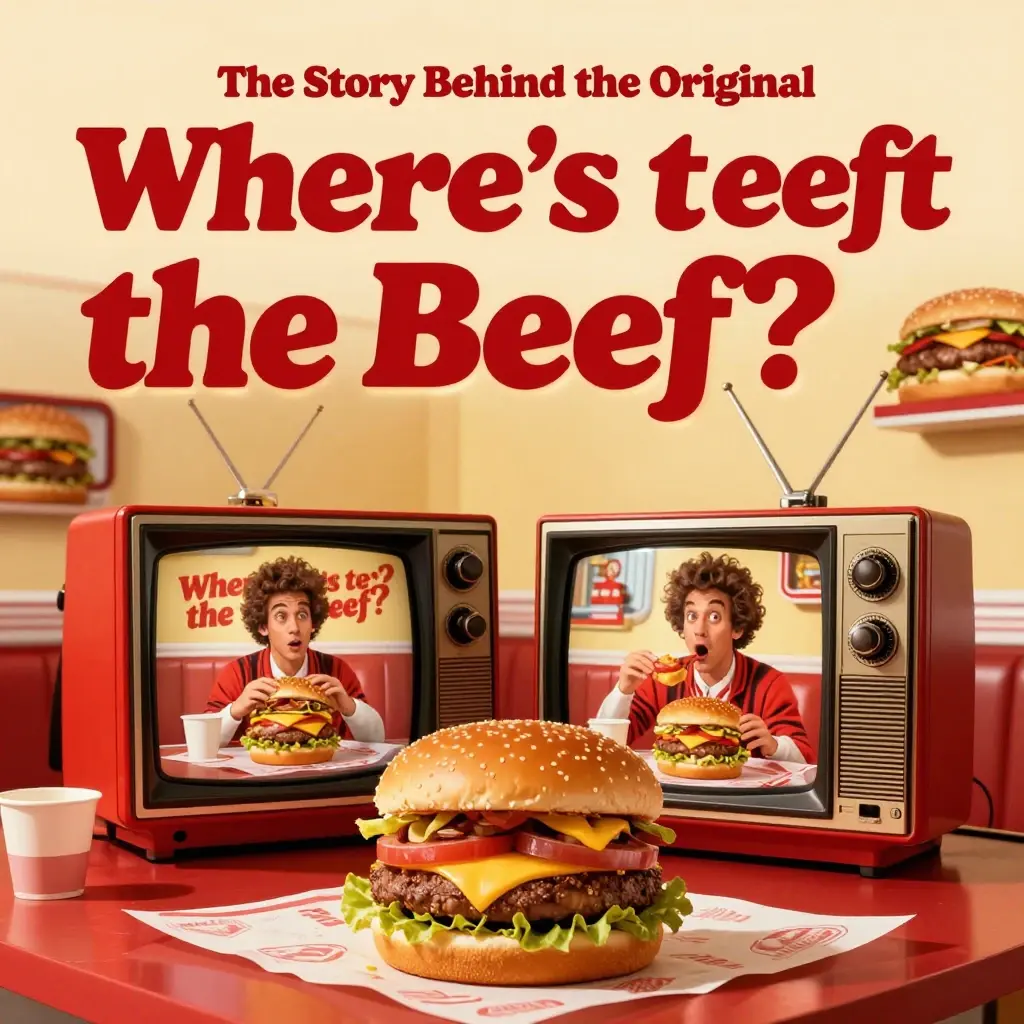
The original commercial placed three elderly women in front of a fictional competitor’s hamburger. Two admired the large bun, but Clara Peller cut through the praise by asking the question customers remembered. The scene transformed a product comparison into a miniature comedy with an unmistakable conclusion. (Wendy’s)ertisement used a simple restaurant setting.**
- 👵 Three older women served as unexpected fast-food spokespeople.
- 🥯 The fictional hamburger had an impressively large bun.
- 🔍 Opening the bun revealed a much smaller piece of meat.
- ❓ Clara Peller responded with the campaign’s defining question.
- 😂 Her direct delivery created the humor.
- 👀 The visual contrast explained the complaint before the dialogue did.
- 🍔 Wendy’s positioned its own burgers as more substantial.
- 🧠 The scene required little effort for viewers to understand.
- ⏱️ The central joke fit comfortably within a short commercial.
- 📢 The phrase sounded natural enough for everyday conversation.
- 🎭 Peller’s character felt impatient, honest, and difficult to impress.
- 🔁 The campaign could repeat the concept in different settings.
- ⚡ The punchline arrived quickly and clearly.
- 🏷️ The brand name benefited from the popularity of the question.
- 📺 Television gave the commercial broad national exposure.
- 📰 News and cultural references amplified its reach.
- 🗣️ People repeated the line without needing to quote the entire advertisement.
- ✅ The commercial showed how one sharp moment can define a campaign.
Wendy’s Slogan History Through the Decades
Wendy’s has used numerous advertising lines since opening in 1969. Campaign dates sometimes overlap because slogans can appear in different countries, media channels, and product promotions. The company’s enduring quality message has remained more stable than many of its temporary television taglines. (Wikipedia)endy’s began with a strong focus on fresh food and quality.**
- 🥇 “Quality Is Our Recipe” became the company’s lasting motto.
- 🔥 “Hot-N-Juicy” emphasized the eating experience of its hamburgers.
- 🧾 “We Fix ’Em 256 Ways” highlighted customization.
- 🍔 “Wendy’s Has the Taste” focused on flavor.
- 🛣️ “Ain’t No Reason to Go Anyplace Else” expressed competitive confidence.
- 👥 “You’re Wendy’s Kind of People” created a customer-centered identity.
- 🍗 “Parts Is Parts” challenged perceptions about processed chicken products.
- ❓ “Where’s the Beef?” became the defining campaign of 1984.
- 🌿 “Choose Fresh, Choose Wendy’s” returned attention to freshness.
- 👨🍳 Later campaigns frequently featured founder Dave Thomas.
- ✅ “It’s Better Here” offered a simple quality comparison.
- 👅 “Do What Tastes Right” focused on personal choice and enjoyment.
- 📣 “That’s Right” used conversational confidence.
- 🍟 “It’s Way Better Than Fast Food. It’s Wendy’s.” sought category distinction.
- 🔍 “You Know When It’s Real” emphasized authenticity.
- 👍 “Now That’s Better” continued the comparative positioning.
- 🟥 “Square’s the Beef” revived a familiar idea through Wendy’s square patties.
- 🕰️ Across these changes, quality and differentiation remained recurring themes.
The Most Memorable Wendy’s Advertising Slogans
Some Wendy’s slogans lasted for years, while others supported shorter campaigns. Memorability does not depend only on duration. A line becomes valuable when it communicates a clear idea, matches a recognizable visual, and gives customers language they enjoy repeating.
- 🥇 “Quality Is Our Recipe” communicates the brand’s central value.
- ❓ “Where’s the Beef?” remains the best-known Wendy’s catchphrase.
- 🥩 “Fresh, Never Frozen” expresses a specific hamburger benefit.
- 🟥 “Square’s the Beef” connects beef quality with patty shape.
- 🔥 “Hot-N-Juicy” uses sensory language.
- 🧾 “We Fix ’Em 256 Ways” highlights customer customization.
- 🍔 “Wendy’s Has the Taste” makes a direct flavor claim.
- 👥 “You’re Wendy’s Kind of People” creates belonging.
- 🌿 “Choose Fresh, Choose Wendy’s” links choice with freshness.
- ✅ “It’s Better Here” communicates confidence in four words.
- 👅 “Do What Tastes Right” invites personal satisfaction.
- 💬 “That’s Right” sounds informal and conversational.
- 🍟 “It’s Way Better Than Fast Food. It’s Wendy’s.” separates the brand from its category.
- 🔍 “You Know When It’s Real” emphasizes authenticity.
- 👍 “Now That’s Better” suggests visible improvement.
- 👨🍳 Dave Thomas commercials often made the founder part of the message.
- 📱 Modern promotional lines frequently adopt Wendy’s playful online voice.
- 🎯 The strongest slogans focus on one central idea.
- 🧠 The most memorable phrases remain understandable without campaign context.
Why Wendy’s Slogans Are Easy to Remember
Memorable slogans usually combine brevity with a clear mental image or emotional response. Wendy’s strongest lines use ordinary language, direct comparisons, rhythm, sensory words, and humor. These features allow the message to survive after the supporting advertisement disappears.
- 🧠 Short phrases place less pressure on working memory.
- 🗣️ Everyday wording makes the lines easy to repeat.
- ❓ Questions invite the audience to respond mentally.
- 😂 Humor encourages people to share the phrase.
- 🍔 Concrete food words create immediate images.
- ⚔️ Competitive contrast gives the slogan a clear purpose.
- 🔁 Repetition strengthens recognition over time.
- 🎵 Natural rhythm improves recall.
- 👀 Strong visuals reinforce the spoken message.
- 👵 Memorable characters give slogans a human voice.
- 🟥 Distinctive product shapes create visual associations.
- 🥩 Specific product claims sound more meaningful than general praise.
- 📣 Confident language makes the brand feel decisive.
- 💬 Conversational wording fits everyday speech.
- 🎯 One-message campaigns prevent confusion.
- 🕰️ Nostalgia can preserve a slogan across generations.
- 📱 Internet culture can revive older phrases.
- 🧩 Flexible wording allows a slogan to work in new contexts.
- ✅ The best Wendy’s slogans feel simple without feeling empty.
How Dave Thomas Shaped the Wendy’s Motto
Dave Thomas opened the first Wendy’s restaurant in Columbus, Ohio, on November 15, 1969. His original concept emphasized made-to-order hamburgers, fresh ingredients, friendly service, and a refusal to cut corners on quality. Those principles explain why “Quality Is Our Recipe” fits the company’s founding story. (Wendy’s)Thomas built Wendy’s around a clear food philosophy.**
- 🏙️ He opened the first restaurant in Columbus, Ohio.
- 📅 The opening took place on November 15, 1969.
- 🍔 The original restaurant specialized in old-fashioned hamburgers.
- 🥩 Fresh beef became an early point of difference.
- 🟥 Square patties made Wendy’s hamburgers visually recognizable.
- 🧾 Customers could choose their preferred toppings.
- 🍟 The first menu included hamburgers, fries, chili, drinks, and the Frosty.
- 🪟 Wendy’s later helped popularize an effective pickup-window model.
- 🤝 Friendly service formed part of Thomas’s restaurant vision.
- 🥇 Quality served as an operating principle rather than a decorative phrase.
- 📺 Thomas later appeared in hundreds of Wendy’s advertisements.
- 🙂 His straightforward style made the brand feel approachable.
- 🗣️ He explained products in a plainspoken manner.
- 👪 His presence connected the national chain with a family-business personality.
- 🧠 Customers could associate the quality promise with a real founder.
- 🏷️ The motto reflected the standards Thomas wanted the company to follow.
- 🕰️ His influence remains visible in Wendy’s brand story.
- ✅ The strongest founder-led branding aligns personality, promise, and operations.
How Wendy’s Square Burgers Reinforce Its Slogan
Wendy’s became known for square hamburger patties that extend beyond the edges of a round bun. The shape gives the brand a visual asset that competitors cannot easily duplicate without appearing imitative. It also supports Wendy’s familiar message that the company does not cut corners. (Wendy’s)are patty makes a Wendy’s burger recognizable at a glance.**
- 🍔 Its corners remain visible beyond the bun.
- 👀 Visible beef supports the idea of a substantial hamburger.
- ✂️ The shape connects naturally with the “no cut corners” message.
- 🧠 A physical difference gives customers an easy memory cue.
- 📸 Square patties stand out in menu photography.
- 📱 They also create recognizable social media content.
- 🏷️ The shape can support product names and promotional phrases.
- ❓ It provides a visual answer to “Where’s the Beef?”
- 🔁 The company can revisit older slogans through the square-burger identity.
- 🎯 Visual branding reduces reliance on words alone.
- ⚔️ The shape separates Wendy’s from round-patty competitors.
- 🛍️ Packaging can repeat square design elements.
- 🏢 Restaurant interiors can use the shape as a brand motif.
- 🎨 Graphic designers can translate it into icons and layouts.
- 🥩 The visible corners keep the focus on the beef.
- 🔍 Customers can recognize the product before seeing the logo.
- 🧩 The shape connects slogans, products, and visual identity.
- ✅ A strong brand asset makes advertising messages easier to prove visually.
How Wendy’s Uses Humor in Its Brand Voice
Wendy’s humor did not begin with social media. “Where’s the Beef?” used comedy to make a product comparison memorable. Modern Wendy’s marketing continues that tradition through playful language, timely cultural references, competitive jokes, and informal customer interactions.
- 😂 Humor makes advertising feel less like a sales presentation.
- 💬 Conversational jokes create a more human brand personality.
- ⚔️ Competitive humor can sharpen a point of difference.
- 🍔 Food remains the central subject of the best jokes.
- 🧠 Unexpected wording improves memorability.
- 📱 Short jokes fit social media formats well.
- 🔥 Playful “roasts” have become associated with Wendy’s online voice.
- 🎯 The humor usually communicates confidence.
- 🗣️ Informal language makes the company sound culturally aware.
- 👀 Topical references help the brand join active conversations.
- 🔁 Recurring humor creates a recognizable personality.
- 👥 Audience participation can extend the life of a joke.
- 📣 People may share entertaining posts even without a promotion.
- ⚠️ Humor still requires boundaries and careful judgment.
- 🤝 A joke should not undermine customer trust.
- 🥩 Product evidence should support any competitive punchline.
- 📊 Engagement alone does not guarantee restaurant sales.
- 🧩 Humor works best when it fits the wider brand identity.
- ✅ Wendy’s strongest comedy combines entertainment with a clear food message.
Wendy’s Social Media Slogan Strategy
Wendy’s social media presence demonstrates why modern brands need more than a fixed tagline. A slogan gives the company a stable idea, while an adaptable brand voice allows it to respond to customers, trends, competitors, new menu items, and cultural moments in real time.
- 📱 Social platforms reward timely communication.
- ⚡ Short responses can attract attention quickly.
- 💬 A consistent voice makes separate posts feel connected.
- 😂 Humor encourages sharing and conversation.
- 🔥 Competitive teasing strengthens Wendy’s confident personality.
- 🍟 Menu references keep entertaining posts commercially relevant.
- 🧠 Familiar language helps audiences recognize the account immediately.
- 👥 Direct replies can make followers feel involved.
- 🎉 Special events create opportunities for interactive content.
- 🗓️ Seasonal campaigns prevent the feed from becoming repetitive.
- 🎮 Games, brackets, and polls invite audience participation.
- 🎥 Short-form video adds visual storytelling.
- 🟥 Square-burger imagery strengthens brand recognition.
- 🥤 Products such as the Frosty provide recurring content themes.
- 🏷️ Campaign hashtags can organize temporary promotions.
- 📣 Viral reach can introduce classic slogans to new generations.
- ⚠️ Fast responses still require brand and legal review processes.
- 📊 Clicks, orders, sentiment, and retention matter alongside likes.
- ✅ A recognizable voice turns individual posts into long-term brand equity.
Wendy’s Brand Positioning and Project Fresh in 2026
Wendy’s introduced Project Fresh in October 2025 as a strategic plan focused on brand revitalization, operational excellence, system optimization, and capital allocation. In 2026, the company continued emphasizing menu improvements, value, order accuracy, customer satisfaction, and international growth. (Irwen’s Wendy’s) Fresh uses freshness as both a strategic and brand concept.**
- 🏢 The plan seeks to strengthen Wendy’s overall business foundation.
- 🍔 Menu improvements form part of the turnaround effort.
- 💰 Value offerings address price-conscious customers.
- 🎯 Brand revitalization aims to improve relevance and demand.
- ⚙️ Operational excellence supports consistent customer experiences.
- ✅ Order accuracy helps turn marketing promises into trust.
- 🙂 Customer satisfaction remains a practical performance measure.
- 🌎 International growth provides another source of expansion.
- 🏪 Restaurant development supports wider market access.
- 🧾 Clear value platforms can simplify customer decisions.
- 🥩 Food quality remains central to the brand’s identity.
- 🔥 Premium menu upgrades can reinforce quality positioning.
- 🍗 Chicken products broaden the brand beyond hamburgers.
- 📱 Digital ordering helps Wendy’s reach convenience-focused customers.
- 🤝 Franchisee execution affects the success of the strategy.
- 📊 Business results ultimately test whether brand messages resonate.
- 🧠 A turnaround name such as Project Fresh connects strategy with existing brand meaning.
- ✅ In 2026, Wendy’s message must balance quality, value, and dependable execution.
How Wendy’s Visual Identity Supports Its Tagline
A slogan becomes stronger when customers see consistent colors, shapes, typography, characters, packaging, and food photography around it. Wendy’s visual identity builds recognition through its red-haired mascot, red color palette, square hamburger patties, and familiar restaurant branding.
- 👧 The Wendy character gives the company a recognizable human symbol.
- 🔴 Red creates strong visibility in signs and digital interfaces.
- 🟥 Square shapes connect the design system with the hamburgers.
- 🍔 Product photography keeps the food at the center of the brand.
- 🥩 Visible patties reinforce the beef-quality message.
- 🏷️ Consistent logo placement improves recognition.
- 📦 Packaging carries the identity beyond the restaurant.
- 🚗 Drive-through signs require immediate visual clarity.
- 📱 App icons need to remain recognizable at a small size.
- 🖥️ Website design can combine promotional messages with ordering tools.
- 👕 Employee uniforms extend the brand into service interactions.
- 🏪 Restaurant exteriors act as large advertising surfaces.
- 🎨 A limited visual system makes campaigns feel connected.
- 🧠 Repeated colors and shapes strengthen memory.
- 📸 Distinctive products improve social-media recognition.
- 🥤 The Frosty adds another visual and product asset.
- 👀 Visual cues can communicate before a customer reads the slogan.
- 🧩 The strongest identity systems connect food, language, and design.
- ✅ Wendy’s slogan works best when the entire brand experience supports it.
Wendy’s Slogan, Tagline, Motto, and Catchphrase Explained
People often use “slogan,” “tagline,” “motto,” and “catchphrase” as if they mean exactly the same thing. They overlap, but marketers can use them for different roles. Understanding these differences explains why several phrases may all appear to be the current Wendy’s slogan.
- 🏷️ A slogan usually communicates a campaign or brand promise.
- 🎯 A tagline often summarizes the brand’s market position.
- 🧭 A motto expresses a lasting principle or belief.
- 🗣️ A catchphrase becomes memorable through repeated public use.
- 🥇 “Quality Is Our Recipe” functions primarily as an enduring motto.
- 🥩 “Fresh, never frozen” functions as a product promise.
- ❓ “Where’s the Beef?” began as an advertising slogan.
- 📣 The phrase later became a cultural catchphrase.
- 🟥 “Square’s the Beef” works as a campaign-specific tagline.
- 📺 Television campaigns may introduce temporary slogans.
- 🌎 International markets may use different wording.
- 📱 Digital promotions may rely on captions instead of formal taglines.
- 🛍️ Packaging can emphasize a product claim rather than the corporate motto.
- 🏢 Investor communications may use broader positioning language.
- 🍔 Menu advertising usually prioritizes appetite and product details.
- 🧠 Customers remember phrases according to personal exposure.
- 🕰️ An old slogan can remain more famous than a newer line.
- 🔄 Brands can use several expressions without abandoning their identity.
- ✅ The role of the phrase matters more than the label marketers give it.
The Psychology Behind the Wendy’s Slogan
A strong slogan reduces a complicated brand into a manageable idea. Wendy’s best-known phrases rely on contrast, curiosity, repetition, sensory language, and recognizable characters. These elements help customers process the message quickly and retrieve it later when making a food choice.
- 🧠 Simple wording reduces the effort required to understand the message.
- ❓ A question creates an unfinished thought the brain wants to answer.
- 🍔 Concrete nouns produce clearer mental images than abstract claims.
- ⚔️ Contrast makes differences easier to notice.
- 😂 Humor creates a positive emotional response.
- 👵 A distinctive spokesperson adds personality.
- 🔁 Repetition strengthens familiarity.
- 🎵 Rhythm makes phrases easier to say aloud.
- 👀 Visual evidence supports verbal claims.
- 🥩 Specific benefits help customers justify a choice.
- 🕰️ Nostalgia can deepen emotional attachment.
- 💬 Conversational language creates social usefulness.
- 📣 A phrase people can quote receives unpaid exposure.
- 🎯 A single focused claim improves comprehension.
- 🟥 Distinctive shapes create additional memory cues.
- 😋 Sensory language can stimulate appetite.
- 👥 Shared cultural references create community recognition.
- ✅ Credible claims reduce skepticism.
- 🧩 The most effective slogans combine emotional and practical value.
How Wendy’s Uses Slogans Across Digital Marketing Channels
A modern fast-food brand reaches customers through websites, apps, search results, delivery platforms, email, social media, digital menu boards, and paid advertising. Each channel has different space, timing, and user-intent requirements, so Wendy’s cannot use every slogan in exactly the same way.
- 🔎 Search pages should answer brand and menu questions clearly.
- 🖥️ The website must connect messaging with ordering actions.
- 📱 The mobile app prioritizes convenience, rewards, and offers.
- 📧 Email subject lines require short promotional language.
- 🔔 Push notifications need immediate relevance.
- 🛵 Delivery listings should emphasize food and availability.
- 📺 Video advertising can build a story around a slogan.
- 🎥 Short-form video needs a fast visual hook.
- 💬 Social replies depend on a recognizable voice.
- 🏷️ Display ads need concise wording and strong branding.
- 🛍️ Product pages should support claims with details.
- 📍 Local search listings need accurate restaurant information.
- ⭐ Customer reviews influence whether slogans feel believable.
- 🎁 Rewards messages can focus on practical value.
- ⏰ Limited-time promotions create urgency.
- 🍔 Menu photography provides visual proof of the product promise.
- 🧠 Consistent themes help customers connect separate channels.
- 📊 Tracking orders and conversions reveals which messages drive action.
- ✅ The slogan should guide the experience without replacing useful information.
How Wendy’s Positioning Differs From Other Burger Chains
Wendy’s has historically differentiated itself through fresh beef, square patties, made-to-order customization, founder-led quality messaging, and a humorous brand voice. Competitors may emphasize familiarity, flame-grilling, low prices, convenience, signature products, or lifestyle associations.
- 🥩 Fresh beef gives Wendy’s a product-centered distinction.
- 🟥 Square patties create immediate visual differentiation.
- ❓ “Where’s the Beef?” challenged competitors on substance.
- 🥇 “Quality Is Our Recipe” focuses on standards.
- 👨🍳 Dave Thomas gave the brand a founder-led personality.
- 😂 Humor helps Wendy’s sound less corporate.
- 📱 Its social voice creates another layer of differentiation.
- 🍔 Made-to-order messaging emphasizes individual preferences.
- 🥤 The Frosty gives Wendy’s a highly recognizable signature product.
- 🌶️ Spicy chicken products broaden its identity.
- 🥔 Baked potatoes provide an alternative to standard fast-food sides.
- 🥗 Salads have supported a wider menu image.
- 💰 Value offerings help the brand compete for budget-conscious visits.
- 🌎 International expansion requires adaptation without losing recognition.
- 🎯 Clear differences make advertising easier to understand.
- ⚠️ A stated difference only matters when customers can experience it.
- ⭐ Reviews and word of mouth influence perceived quality.
- 🧩 Products, service, pricing, and personality shape positioning together.
- ✅ Wendy’s strongest position combines quality with an approachable attitude.
Marketing Lessons Businesses Can Learn From Wendy’s Slogans
Small restaurants and growing food companies should not copy Wendy’s language. They can study the principles behind it. Effective slogans identify a real difference, use language customers understand, and connect the promise with an experience the business can deliver consistently.
- 🎯 Build the slogan around one clear idea.
- 🔍 Choose a difference customers can recognize.
- 🗣️ Use language people naturally say.
- ✂️ Remove words that do not add meaning.
- 😂 Use humor only when it fits the brand.
- 👀 Support verbal claims with visual proof.
- 🍽️ Connect the slogan to the actual product experience.
- ✅ Make only claims the business can support.
- 🧠 Test whether people remember the line after one exposure.
- 📣 Read the slogan aloud before approving it.
- 📱 Check how it looks on small screens.
- 🏷️ Place it beside the logo to test visual balance.
- 📦 Make sure it remains readable on packaging.
- 🌎 Consider how the words translate across markets.
- ⚖️ Conduct appropriate trademark research.
- 👥 Ask real customers what they think the slogan means.
- 🔄 Allow campaign taglines to change while core values remain stable.
- 📊 Measure whether the message improves awareness and action.
- 🤝 Train employees to deliver the promise behind the words.
Common Myths About the Wendy’s Slogan
Online articles often identify one phrase as Wendy’s only slogan without explaining its purpose, date, or market. This creates confusion between the corporate motto, current product positioning, famous historical campaigns, and temporary promotional lines.
- ❌ Myth: “Where’s the Beef?” is Wendy’s only slogan.
- ✅ Reality: Wendy’s has used many campaign lines throughout its history.
- ❌ Myth: “Where’s the Beef?” began as a general political expression.
- ✅ Reality: Wendy’s introduced it through a 1984 hamburger commercial.
- ❌ Myth: “Fresh, never frozen” applies identically in every country.
- ✅ Reality: Wendy’s states geographic qualifications for its fresh-beef claim.
- ❌ Myth: “Quality Is Our Recipe” refers only to a cooking recipe.
- ✅ Reality: It represents a wider company principle.
- ❌ Myth: A brand can use only one slogan at a time.
- ✅ Reality: corporate, product, and campaign messages can coexist.
- ❌ Myth: The longest-running slogan is always the most famous.
- ✅ Reality: “Where’s the Beef?” gained exceptional cultural recognition.
- ❌ Myth: A funny slogan does not need a product benefit.
- ✅ Reality: Wendy’s strongest humor supports a competitive point.
- ❌ Myth: Social media replaced the need for a brand position.
- ✅ Reality: social content works better when a stable identity guides it.
- ❌ Myth: A slogan alone can repair a weak customer experience.
- ✅ Reality: operations must deliver the advertised promise.
- 💡 Clear context prevents readers from confusing mottos, claims, and campaigns.
FAQs:
Q1. What is Wendy’s slogan in 2026?
A: “Quality Is Our Recipe” remains Wendy’s enduring brand motto. “Fresh, never frozen” expresses its core beef promise in the contiguous United States, Alaska, and Canada. Wendy’s may also use temporary campaign lines for specific products and promotions. (Wendy’s)’s slogan “Where’s the Beef?”
B: “Where’s the Beef?” is Wendy’s most famous historical advertising slogan. It debuted in a 1984 commercial and became a popular expression for questioning whether something had enough substance. (Wendy’s)s “Quality Is Our Recipe” mean?
C: The phrase means that Wendy’s presents quality as a guiding principle across ingredients, food preparation, innovation, sourcing, safety, and customer experience. It works as both a food-related statement and a broader company motto.
Q2. Who said “Where’s the Beef?” in the Wendy’s commercial?
A: Actress Clara Peller delivered the famous line in the original Wendy’s campaign. Her distinctive delivery helped transform the advertising question into a national catchphrase.
Q3. When did the “Where’s the Beef?” commercial come out?
A: The original campaign appeared in 1984. Wendy’s later revisited the slogan and its underlying idea in anniversary promotions and square-burger advertising.
Q4. Why are Wendy’s hamburger patties square?
A: The square shape makes the patties visually distinctive and allows the corners to extend beyond the round bun. It also supports Wendy’s familiar message that the company does not cut corners.
Q5. Does Wendy’s use fresh or frozen beef?
A: Wendy’s says it uses fresh, never-frozen North American beef in the contiguous United States, Alaska, and Canada. Customers in other markets should review local Wendy’s information because sourcing and product practices may vary. (Wendy’s)ted Wendy’s?
B: Dave Thomas founded Wendy’s and opened the first restaurant in Columbus, Ohio, on November 15, 1969. He named the restaurant after his daughter, Melinda Lou “Wendy” Thomas. (Wendy’s) Wendy’s first slogan?
C:“Quality Is Our Recipe” is widely recognized as Wendy’s original and longest-lasting motto. It reflects Dave Thomas’s founding emphasis on quality ingredients and freshly prepared food.
Q6. What does “Square’s the Beef” mean?
A: “Square’s the Beef” is a modern reference to both Wendy’s square hamburger patties and the classic “Where’s the Beef?” campaign. It uses nostalgia while bringing attention back to a recognizable product feature. (Wendy’s)“Where’s the Beef?” so successful?
B: The slogan combined a short question, a visual joke, a memorable spokesperson, and a clear competitive claim. People could also use the phrase outside the restaurant context, which helped it spread through popular culture.
Q7. Can another restaurant use a Wendy’s slogan?
A: Businesses should not copy Wendy’s protected branding or create language likely to confuse customers. A restaurant should develop an original slogan and complete appropriate trademark research before using it commercially.
Conclusion:
The Wendy’s slogan cannot be reduced to one advertising phrase without context.
“Quality Is Our Recipe” remains the company’s enduring motto.
“Fresh, never frozen” communicates a central hamburger promise.
“Where’s the Beef?” remains the unforgettable historical campaign that transformed a competitive food claim into a cultural expression.
Benjamin Collins is a branding researcher who explores the psychology behind memorable slogans and successful brand identities.